A Walk Through Revelation 8 (Part Three): Verses 8-9
By Robert E. Cruickshank, Jr. (September 10, 2026)
[5-Minute Read Time]
This series of articles is adapted from my 2026 Berean Conference messages on Revelation 8, which can be found here and here, and follows my previous article on verses 1-6 and on verse 7.[1]
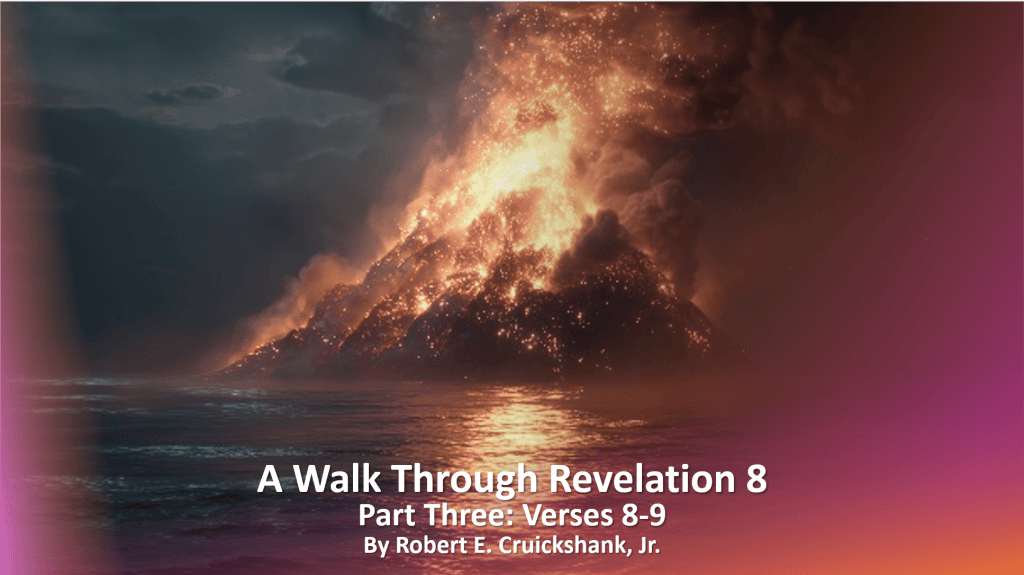
“The second angel sounded, and something like a great mountain burning with fire was hurled into the sea; and a third of the sea became blood, and a third of the creatures which were in the sea and had life, died; and a third of the ships were destroyed” (Rev. 8:8-9).
This verse begins to mix things that are more literal in fulfillment with imagery that is definitely more symbolic in nature. Specifically, a great mountain burning with fire is said to be hurled into the sea.
The Biblical hermeneutic isn’t either literal or symbolic, it’s both literal and symbolic. The Bible often goes from speaking about very literal things to very symbolic things in the space of just a few verses. The interplay between the two frequently jumps off the pages, and it’s so seamless that it sometimes escapes notice.
Curiously enough, this often happens when the Biblical writers start talking about mountains.
Singing Mountains and Burning Mountains
A good case in point is Psalm 98. Verses 4-6 talk about shouting and singing to the Lord and praising Him with musical instruments. This is distinctly literal. But verses 7-8 talk about the rivers clapping their hands and the mountains singing with joy. This is definitely not literal. Rivers can’t clap; they don’t have hands. And mountains can’t sing; they don’t have vocal cords.
John’s fiery mountain being hurled into the sea is no more literal than the Psalmist’s singing mountains shouting for joy.[2]
In other words, John’s using a metaphor – and it’s not hard to see what it is a metaphor for.
In the book of Revelation, apostate Israel becomes the new Babylon. With that in mind, notice what Jeremiah says about the old Babylon (cf. Jer 51:12) in the Old Testament:
“‘Behold, I am against you, O destroying mountain,
That destroys the whole earth,’ declares the Lord,
‘And I will stretch out My hand against you,
And roll you down from the rocky cliffs,
And I will make you a burnt-out mountain’” (Jer. 51:25).
So, Babylon is called a burnt-out mountain. Also notice what Jeremiah says a little later in the chapter about this burnt-out mountain:
“Babylon has become an object of horror among the nations!
The sea has come up over Babylon;
She has been engulfed by its roaring waves” (Jer. 51:41b-42).
It’s a burning mountain tossed into the sea – just like the Revelation 8:8 imagery.
From Babylon to Jerusalem
The irony here, that really shows the metaphorical nature of the language, is that Babylon wasn’t a mountain at all. Babylon was located on the fertile plain of Lower Mesopotamia, between the Tigris and Euphrates rivers, and not on any mountain. And the city itself was in an area far from any major mountains.[3]
Babylon is portrayed as a mountain because “a ‘mountain’ often symbolizes a kingdom or dominion (Isaiah 2:2; Daniel 2:35,44-45). Mountains convey durability, loftiness, and geopolitical strength. Thus Babylon—though situated on a flat Mesopotamian plain—stands metaphorically as a towering kingdom.”[4]
So, in the Old Testament, Babylon is the burning mountain that is thrown into the sea. And beginning in chapter 14 of Revelation, John is going to start identifying Jerusalem as the new Babylon (Rev. 14:8; 16:19; 17:5; 18:2, 10, 21).[5] He begins laying the groundwork for this equation right here with the burning mountain imagery in Revelation 8:8.
If John’s readers were familiar with their Old Testament, they would have gotten it right away.
A Plunge Into Chaos
Next, this burning mountain (Jerusalem – the new Babylon) is hurled into the sea. Random and unpredictable, the sea was a symbol of chaos in the ancient world. The imagery makes sense.
Thus, John portrays Jerusalem (the burning mountain) as being plunged into a sea of chaos.
He then highlights the results of Jerusalem’s chaotic plunge, as a third of the sea became blood, and a third of the creatures which were in the sea and had life, died; and a third of the ships were destroyed.[6]
As Ken Gentry comments, “This imagery…involves a historical component reflecting the sea battles on various bodies of water during the Jewish War.”[7]
Shipwrecks at Joppa
An example of this is recorded by Josephus where he recounts a great number of Jews escaping out of the demolished cities of Judea, while Vespasian was in Caesarea.[8] These Jews decided to flee to Joppa, which had been left desolate by Cestius, as “a place of refuge.” [9]
Joppa was a port city about 35 miles northwest of Jerusalem, and 30 miles south of Caesarea.[10] It’s where Jonah fled when the Lord told him to go to Nineveh (Jon. 1:1-3). As the reader might recall, things didn’t go well for Jonah there (Jon. 1:4). Ironically, things didn’t go well for the first-century Jews who fled to Joppa either.
Because the “region had been” so “laid waste in the war, and was not capable of supporting them, they determined to go off to sea.”[11] According to Josephus, they built numerous small ships and turned to piracy along the coasts of Syria, Phoenicia, and Egypt. Basically, they would seize the goods and resources of other ships and then return to their safe haven in Joppa.[12]
When Vespasian got news of this, he wasn’t all too happy, and he sent troops to attack the city by night. Upon the arrival of Vespasian’s forces, the Jews in Joppa fled to their ships and anchored offshore. But at dawn, a violent “north wind” arose, driving their vessels against one another and onto the sharp rocks – destroying them completely.[13]
Thousands perished by drowning or shipwreck, with some even taking their own lives, until the sea was red with blood and the shore was littered with corpses. Josephus described the ships being dashed to pieces against the rocks, as “a great many were embarrassed with shipwrecks.”[14]
Josephus’s narrative of the massive shipwrecks and the bloody sea – off the coast of Joppa – reads like a commentary of Revelation 8:8-9.
Trouble at Sea in Capharnaum
A similar instance took place in a lake off the shores of Capharnaum.[15] The Jews’ ships were “small and fitted only for piracy,” and “too weak to fight with” Vespasian’s larger vessels.[16]
To overcome their disadvantage, the Jewish pirates would try to get close enough to Vespasian’s ships so they could throw “stones at the Romans.”[17] This resulted in the Romans leaping onto their ships, with swords in hand, slaying them, and destroying their ships.[18]
Josephus relates how Vespasian’s forces “encompassed them about the sea,” and records the gruesome results:
“One might then see the lake all bloody, and full of dead bodies, for not one of them escaped. And a terrible stink, and a very sad sight there was on the following days over that country; for as for the shores they were full of shipwrecks, and of dead bodies all swelled; and as the dead bodies were inflamed by the sun, and putrified, they corrupted the air, insomuch that the misery was not only the object of commiseration to the Jews, but to those that hated them, and had been the authors of that misery. This was the upshot of the sea fight. The number of the slain, including those that were killed in the city before, was six thousand and five hundred.”[19]
What John foresaw in his prophecy, Josephus recorded in his history.
Recap
Drawing from Jeremiah’s portrayal of Babylon as a burning mountain overwhelmed by the sea, John portrays Jerusalem (the new Babylon) as being plunged into the chaos of God’s judgment. The sea battles and blood-filled waters that accompanied the Roman-Jewish War were the historical outworkings that echoed the second trumpet’s sounding in Revelation 8:8-9.
Our next installment will pick up with verse 10, and the star that falls like a torch named “wormwood.”
___________________________________________________
[1] Thanks to my friends, Brett Prieto and Daniel E. Harden, for their input and suggestions in this installment.
[2] David Chilton also sees a connection to Matthew 21:21-22: “Connect this with the fact that Jesus, in the middle of a lengthy series of discourses and parables about the destruction of Jerusalem (Matt. 20-25), cursed an unfruitful fig tree, as a symbol of judgment upon Israel. He then told his disciples, ‘Truly I say to you, if you have faith, and do not doubt, you shall not only do what was done to the fig tree, but even if you say to this mountain, ‘Be taken up and cast into the sea,’ it shall happen. And all things you ask in prayer, believing, you shall receive” (Matt. 21:21-22). Was Jesus being flippant? Did He really expect His disciples to go around praying about moving literal mountains? Of course not. More importantly, Jesus was not changing the subject. He was still giving them a lesson about the fall of Israel. What was the lesson? Jesus was instructing His disciples to pray imprecatory prayers, beseeching God to destroy Israel, to wither the fig tree, to cast the apostate mountain into the sea” (The Days of Vengeance: An Exposition of the Book of Revelation (Ft. Worth, TX: Dominion Press, 1987), 238-239).
[3] Babylon in the Mesopotamian plain | Babylon https://bit.ly/42qmhx4
[4] Why is Babylon described as a “destroying mountain” in Jeremiah 51:25? https://bit.ly/4n7kAMF
[5] On identifying Babylon as a symbol of Jerusalem in Revelation, see: Gentry, “Redemptive-Historical Excurses 13” (The Divorce of Israel, Vol. II), 1258-1274.
[6] Jerusalem is well-known for its commerce via waterways. Back as far as Solomon’s time, Jerusalem benefited from merchandising by sea. Solomon built a fleet of ships near the Red Sea (1 Kg. 9:26) and did business with Hiram, King of Tyre (1 Kg. 9:27). Every three years, the ships of Tarshish “came bringing gold and silver, ivory, apes and peacocks” (1 Kg. 10:22). The Psalmist says: “Those who go down to the sea in ships, Who do business on great waters; They have seen the works of the Lord, And His wonders in the deep” (Ps. 107:23-24). 1 Maccabees speaks of Simon the great high priest opening the way to the isles of the sea (1 Macc. 13:42; 14:5). Josephus speaks of “the sweet-smelling spices” in the temple “which the sea replenishes” (Wars, 5.5.5) and notes that Judea was not destitute of the delights which come from the sea – as its maritime commerce extended as far as Ptolemais (Wars, 3.3.5). The Jewish Mishnah even discusses proper tithing on shipped products that are brought in by way of the sea (m. Hal. 2:2). Those who engaged in such sea-faring commerce and trade would have “stood at a distance” (Rev. 18:17) watching as the smoke went up from the burning city.
[7] Gentry, The Divorce of Israel, Vol. I, 762.
[8] Josephus, Wars, 3.9.1 – 3.9.2.
[9] Josephus, Wars, 3.9.2.
[10] On the location of Joppa, see: Joppa (BiblePlaces.com) https://bit.ly/4mRebou ; What is the significance of Joppa in the Bible? | GotQuestions.org https://bit.ly/4nySGdc
[11] Josephus, Wars, 3.9.2.
[12] Josephus, Wars, 3.9.1 – 3.9.2.
[13] Josephus, Wars, 3.9.3
[14] Josephus, Wars, 3.9.2.
[15] Josephus, Wars, 3.10.8.
[16] Josephus, Wars, 3.10.9.
[17] Josephus, Wars, 3.10.9.
[18] Josephus, Wars, 3.10.9.
[19] Josephus, Wars, 3.10.9.