
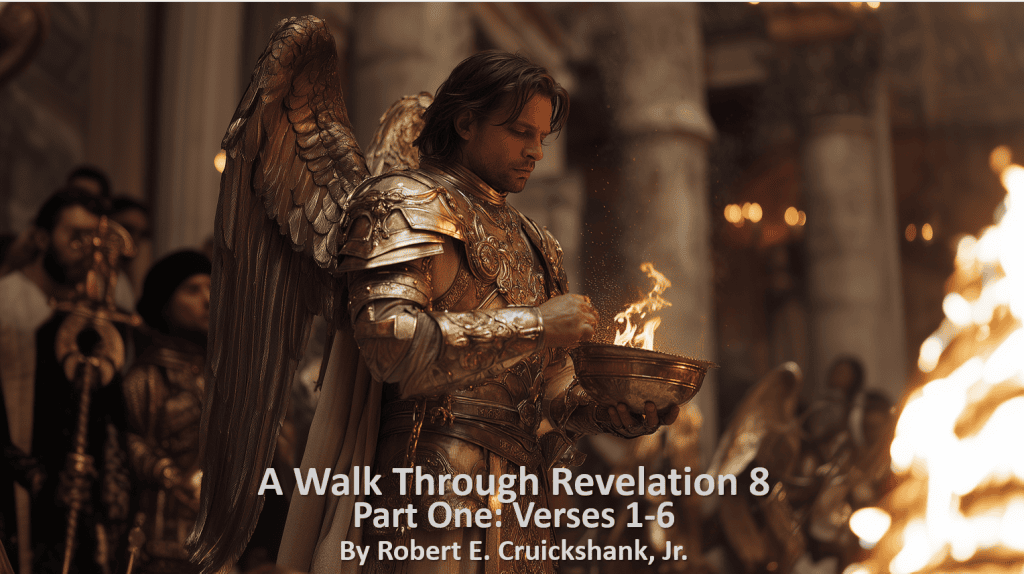
A Walk Through Revelation 8 (Part One): Verses 1-6
By Robert E. Cruickshank, Jr. (July 29, 2026)
[6-Minute Read Time]
This series of articles is adapted from my 2026 Berean Conference messages on Revelation 8, which can be found here and here.[1]
“When the Lamb broke the seventh seal, there was silence in heaven for about half an hour” (Rev. 8:1).
The Lamb breaking the seventh seal is followed by a half an hour of silence in heaven. We know that the earthly temple was patterned after the heavenly temple (Heb. 8:5). Accordingly, this verse is the heavenly counterpart to the half hour of silent prayer every morning in the temple, during the incense burning, after the lamb had been slain.[2] Here in Revelation 8, the Lamb who was slain before the foundation of the world opens the seventh seal and 30 minutes of silence follows.
Alfred Edersheim notes the correspondence between the earthly ritual and the heavenly scene:
“It is this most solemn period, when throughout the vast Temple buildings deep silence rested on the worshiping multitude…which serves as the image of heavenly things in this description.”[3]
Taken together then, what John sees in the heavenly vision perfectly parallels the earthly liturgy or Horarium.[4] This points toward an early date for the book of Revelation. The temple tradition of 30 minutes of silence would have been fresh on the readers’ minds while the temple was still standing (pre-AD 70). But not nearly as much 25 years after its destruction (AD 95).[5] As Richard Bauckham puts it:
“This passage must date from before A.D. 70…It is hard to see how the account…could have been composed by anyone other than a Jew before the destruction of the temple, and so probably the Horarium as a whole dates from the period of the second temple.”[6]
Beyond its liturgical connection to the temple services, silence also functions as a powerful portent in the Old Testament – preceding either judgment or salvation. For example, silence heralded the destruction of Jerusalem the first time at the hands of the Babylonians (Zeph. 1:7), and the restoration of Jerusalem after the return from Babylonian exile (Zech. 2:12-13).
The silence here in Revelation 8:1 signals both judgment and salvation, in terms of Jerusalem. God destroys the old earthly Jerusalem, which rejected its Messiah, and saves the new heavenly Jerusalem, which is made up of those who embrace and accept Jesus as their Messiah.
“And I saw the seven angels who stand before God, and seven trumpets were given to them” (Rev. 8:2).
In Jewish literature, there were seven specific angels, known as the archangels, or angels of the presence.[7] These were an elite group who stood directly in the presence of God, and we know two of them from Scripture – Michael and Gabriel. As Gabriel tells Zacharias, “I am the angel Gabriel, who stands in the presence of God; and I’ve been sent to speak to you and bring you good news” (Lk. 1:19).[8]
Gabriel’s interaction with Zacharias shows that the seven archangels, who stand in the presence of God, don’t just stand around and do nothing. They move from God’s presence in heaven to the earthly realm – to accomplish God’s purposes in this realm. That is to say, they spring into action when the time for action comes.
Springing into action is exactly what is signified by the seven trumpets that were given to them. In the Old Testament, trumpets were blown before worship assemblies (Lev. 23:24; Num. 10:10; 29:1; 1 Chr. 15:24; Neh. 12:41) and before war to call soldiers to battle (Num. 10:9; Judg. 6:34; Job 39:25).[9]
Here in Revelation 8, John is merging both aspects: the call to worship and the call to war – with the blowing of the trumpets. The worship aspect is clearly there with the incense and the prayers of the saints (cf. Rev. 8:3), and the warfare aspect is coming up as the judgments unfold in the verses to follow.
Additionally, trumpets were also a warning call against God’s own people when they were in a state of rebellion. For example, after the call to silence in Zephaniah 1:7, the prophet says, “Near is the great day of the Lord – near and coming very quickly. Listen, for the day of the Lord!” (Zeph. 1:14). Then, Zephaniah calls the day “a day of trumpets and a battle cry against the fortified cities and the high towers” (Zeph. 1:16) “because they have sinned against the Lord” (Zeph. 1:17).
The second time (AD 70) mirrors the first time (586 BC), and the trumpets signified that the day of Jerusalem’s destruction was “near” and coming very “quickly” once again (cf. Rev. 1:1, 3).
“Another angel came and stood at the altar, holding a golden censer; and much incense was given to him, so that he might add it to the prayers of all the saints on the golden altar which was before the throne. And the smoke of the incense ascended from the angel’s hand with the prayers of the saints before God. Then the angel took the censer and filled it with the fire of the altar, and hurled it to the earth; and there were peals of thunder and sounds, and flashes of lightning and an earthquake. And the seven angels who had the seven trumpets prepared themselves to sound them” (Rev. 8:3-6).
The prayers of the first century saints went into motion as the angels leaped into motion, and their cries were answered with the fire of God’s judgment in AD 70. And this again reflects the judgment on Jerusalem the first time in 586 BC. The fire from the altar being thrown to the earth in Revelation 8:5 echoes the same sort of imagery being used in Ezekiel chapter 10:
“And He spoke to the man clothed in linen and said, ‘Enter between the whirling wheels under the cherubim and fill your hands with coals of fire from between the cherubim and scatter them over the city.’ And he entered in my sight” (Ezekiel 10:2).
In Ezekiel chapter 11, we see how this played out in history. Ezekiel says,
“‘You have feared a sword; so I will bring a sword upon you,’ the Lord God declares. ‘And I will bring you out of the midst of the city, and hand you over to strangers, and execute judgments against you. You will fall by the sword. I will judge you to the border of Israel; so you shall know that I am the Lord’” (Ezekiel 11:8-10).
The swords of the Babylonians were the coals of fire from the altar in Ezekiel, and the swords of the Romans were the coals of fire from the altar in Revelation. But the fire is not merely metaphoric. As is often the case, the symbolic mixes with the literal when God’s judgments are poured out, and the Roman historian Tacitus tells us:
“Contending armies were seen circling the skies, their arms flashed, and suddenly the temple was illumined with fire from the clouds. Of a sudden the doors of the shrine opened and a superhuman voice cried: ‘The gods are departing,’ at the same moment the mighty stir of their going was heard” (Tacitus Histories, Book V, Verse 13).[10]
As this judgment unfolds, John says that there were peals of thunder and sounds, and flashes of lightning and an earthquake. Overall, this verse seems to take on a very real, concrete, historical fulfillment. In conjunction with the Idumeans coming to Jerusalem to free the Zealots who were imprisoned in the temple in February of 68,[11] Josephus writes:
“For there broke out a prodigious storm in the night, with the utmost violence, and very strong winds; with the largest showers of rain; with continual lightnings, terrible thunderings, and amazing concussions and bellowings of the earth that was in an earthquake. These things were a manifest indication that some destruction was coming upon men, when the system of the world would be put into disorder; and anyone would guess that these wonders foreshadowed the grand calamities that were coming” (Josephus, Wars, 4.4.5).[12]
History reflects prophecy, as John talks about lightning and thunder combined with an earthquake, and Josephus records lightning and thunder combined with an earthquake.
These stormy historical realities only got worse. In the following year, the year of the four emperors, Tacitus says, “Never had the storms of lightning flashed with more frequent violence.”[13] The symbolic imagery mixes with the historical realities as God’s judgment unfolds.
It is also worth noting that the word translated as “sounds” is often translated as “voice,” and carries the idea of “noise of any kind.”[14] Strikingly, the “noise” of verse 5 is a direct contrast to the “silence” of verse 1. The message is that the prayers have gone up, heaven has heard those prayers, and things are about to get noisy. In the following verses, things indeed get noisy when the seven angels with the seven trumpets prepare themselves to sound those trumpets.
Our next installment will pick up with verse 7, as the trumpets begin to sound.
______________________________________________________________________________________________________________________________________
[1] These articles are abridged and abbreviated versions. For a more thorough treatment, you’ll want to listen to the presentations at the conference. Many thanks to Ed Stevens and Eric Ogea for their input and suggestions, and for catching some typos. Any remaining errors in this regard are solely the result of yours truly!
[2] Gentry cites Bauckham, Wilson, Slater, Aune, Smalley, and Chilton as examples of those who recognize the correlation of the 30 minutes of silence each morning in the earthly temple with John’s vision in Revelation 8:1-4 (The Divorce of Israel, Vol. 1, [Acworth, GA: Tolle Legg Press, 2024], 737).
[3] Alfred Edersheim, The Temple: Its Ministry and Services as They Were at the Time of Jesus Christ (Grand Rapids: William B. Eerdmans, 1980), 167.
[4] A horarium is a daily schedule that outlines the routines, tasks, and sacred hours of a religious community and/or ceremony. For example, see: Horarium | Aleteia https://bit.ly/4fHlIET
[5] For a balanced look at the issues involved in determining the date of Revelation, see: Dr. Richard J. Krejcir, Research insights into the Date of Revelation | Into Thy Word https://bit.ly/4fLvlCz ; for a defense of the early date, see: Kenneth L. Gentry, Jr., Before Jerusalem Fell https://bit.ly/4fsxTXf ; see also: Shane Rosenthal, A Pre-70 Date for Revelation? | The Humble Skeptic https://bit.ly/3RluP6d
[6] Richard Bauckham, The Climax of Prophecy: Studies on the Book of Revelation (Edinburg, Scotland: T&T Clark, 1993), 80-81.
[7] “The scene opens with a reference to the seven angels who stand before God. This description identifies them as the seven archangels, the angels of the Presence or ‘the Face’ (cf. Tob. 12:15; Jub. 2:18 15:27; 31:14; Lk. 1:19; T Levi 8:2 ; 1 En. 81:5; 87:2), They are probably to be identified with the ‘seven spirits’, who are in a similar position ‘before the throne’” (see on 1:4; cf. 4:5; 5:6)” (Ian Boxall, The Revelation of St. John: Black’s New Testament Commentaries [Peabody, MA: Hendrickson Publishers, 2006], 132).
[8] Incidentally, Gabrial comes to Zacharias with this announcement “while he was performing his priestly service before God in the appointed order of his division, according to the custom of the priestly office, he was chosen by lot to enter the temple of the Lord and burn incense. And the whole multitude of the people were in prayer outside at the time of the incense offering” (Luke 1:8-10). In other words, the archangel comes to him during the earthly ritual to which Revelation 8:1 is the heavenly counterpart – as in the comments on verse 1.
[9] For more on the significance of the trumpet imagery, see: Michael S. Heiser, The Old Testament in Revelation: Notes from the Naked Bible Podcast (Naked Bible Press, 2021), 159-161; See also: Sigve K. Tonstad, Revelation – Paideia: Commentaries on the New Testament (Grand Rapids, MI: Baker Publishing Group, 2019), 142.
[10] Tacitus Histories – Book V https://bit.ly/41Fzjqc
[11] See: Edward E. Stevens, The War Chronology, 13.
[12] Josephus, Of the War — Book IV https://bit.ly/469kayz
[13] The Annals (Tacitus)/Book 15 https://bit.ly/4mRS6aa
[14] “φωνή (fōnē) ‘voice/sound: noise’ (G5456H): noise/sound voice, sound, tone, noise of any kind; by extension: speaking, language” (STEP Bible, Tyndale House).