A Walk Through Revelation 8 (Part 4): Verses 10-12
By Robert E. Cruickshank, Jr. (November 12, 2026)
[6-Minute Read Time]
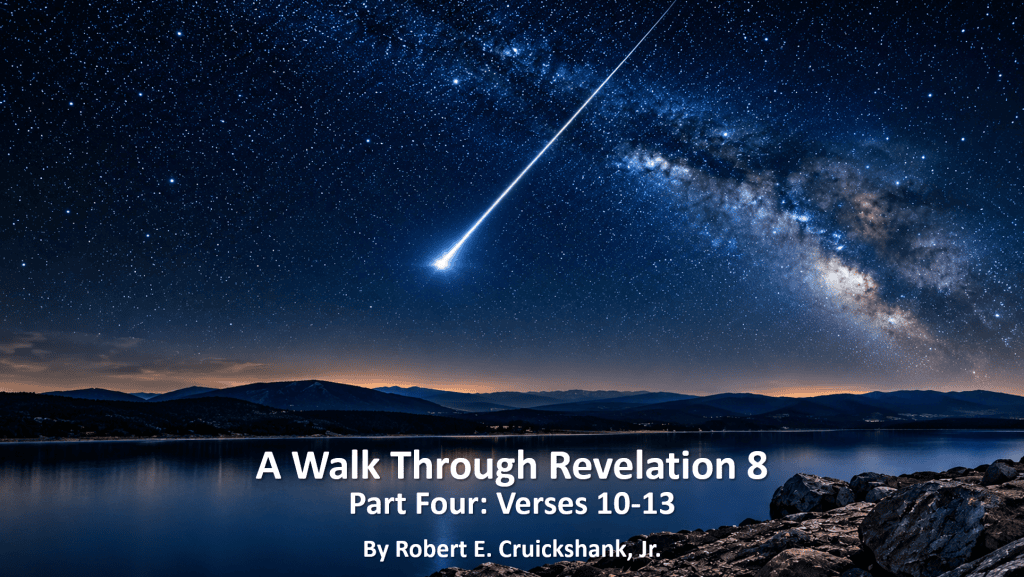
“The third angel sounded, and a great star fell from heaven, burning like a torch, and it fell on a third of the rivers and on the springs of waters” (Revelation 8:10).
When the third angel sounded, a great star fell from heaven. In the Old Testament, the imagery of stars falling from heaven signifies the downfall of human leaders from their high and lofty positions. For example, the downfall of the king of Babylon in Isaiah 14:12 and the demise of the proud nation of Edom in Obadiah 4. In Daniel 8:10, the stars being thrown down to the earth symbolizes the Jewish leadership being trampled by Antiochus Epiphanes.
John says that this great star, which fell from heaven, was burning like a torch.[1] In Zechariah 12:6, the clans of Judah are likened to a “flaming torch among sheaves.” In Isaiah 62:1, Jerusalem in all her glory is “like a burning torch.” God’s Old Testament people were like a flaming torch when they were in the brightness of their glory and walking in obedience to Him. But when God’s people were in rebellion, and He sent them into exile, Jeremiah says, “He cast down from heaven to earth the glory of Israel” in “the day of His anger” (Lam. 2:1).
With the backdrop of this Old Testament imagery, the picture that John is painting is that of Israel’s leadership being toppled from its exalted position because of its rebellion against God. The people who once shone in glory would now taste the bitter consequences of their rebellion.
The rebellious teachings of the fallen leadership fell on a third of the rivers and on the springs of waters. Solomon tells us that the mouth of the righteous and the teaching of the wise was a fountain of life (Prov. 10:11; 13:14), but the righteous man who gives way to the wicked is like a muddied spring or polluted fountain (Prov. 25:26).[2]
Contra what they were supposed to be, the failure of first-century Israel’s leadership had poisoned the very sources of spiritual water from which the people were supposed to receive life, instruction, and spiritual nourishment.
“The star is named Wormwood; and a third of the waters became wormwood, and many people died from the waters because they were made bitter” (Revelation 8:11).
Picking up on the theme of the previous verse, this fallen star is named Wormwood. When God’s people rebelled in Old Testament times, the Lord said, “Behold, I will feed them, this people, with wormwood and give them poisoned water to drink” (Jer. 9:15). Jeremiah reiterates this again later:
“Therefore, thus says the LORD of hosts concerning the prophets, ‘Behold, I am going to feed them wormwood and make them drink poisonous water. For from the prophets of Jerusalem Pollution has gone forth into all the land’” (Jer. 23:15).
As Eric Ogea comments on these passages, in conjunction with Revelation 8:
“Wormwood is a symbol of God’s judgment on apostasy. Apostasy means falling from the true faith. So this would make Israel the main focus of this trumpet. As an example, in Jeremiah, God feeds his people and the prophets wormwood as judgment and punishment for apostasy. Wormwood appears six other times in the Old Testament and is always used figuratively.[3]
As in the Old Testament, Wormwood for John signifies the pollution and corruption of rebellion as the waters became wormwood, and many people died from the waters because they were made bitter. In short, John’s falling star is a portrait of Israel’s corrupt leadership being cast down in judgment. It’s a picture of their once-bright torch burning out and becoming a bitter drink for the people they misled. Death would indeed result, as the city would be judged for its poisonous and bitter rejection of Christ, through its destruction by the Romans.
“The fourth angel sounded, and a third of the sun, a third of the moon, and a third of the stars were struck, so that a third of them would be darkened and the day would not shine for a third of it, and the night in the same way” (Rev. 8:12).
As we’ve seen, celestial language, like stars falling from heaven, is used poetically in the Bible to describe the downfall and demise of human leadership. In this verse, John includes a third of the sun and a third of the moon, along with a third of the stars that were struck.
In the Old Testament, we’re told that “he who rules over men righteously, who rules in the fear of God, is as the light of the morning when the sun rises, a morning without clouds” (2 Sam. 23:3-4). This is what leadership is supposed to be like when it’s functioning properly and ruling in the fear of the Lord. In contrast to this, Micah describes the downfall of Israel’s leadership in terms of the stark opposite: “The sun will go down over the prophets, the day will become dark over them” (Mic. 1:6).
The language is strikingly similar to Revelation 8:12, as John says that a third of the celestial lights would be darkened and the day would not shine for a third of it, and the night in the same way.
Ken Gentry summarizes John’s use of the imagery:
“Revelation’s theological point here is that God is darkening the sky over Israel, whereas those whom they persecute – the Christians – are inheriting the new creation in which they will enjoy light, not from the sun but from God and the Lamb.”[4]
John’s continual use of the one-third theme throughout the chapter is meant to convey the idea that God’s not finished yet. As Stephen Smalley comments:
“John uses the expression ‘one-third’ (to triton, with the genitive) insistently in this passage (12 times between verses 7 and 12; cf. also 9.15, 18; 12.4). The fraction cannot be taken literally. It rather indicates that God’s judgement is not yet final.”[5]
In other words, there are more trumpets to sound, and more judgments to come. With the continual use of a third, Chapter 8 is ramping up for what’s coming up, as the final verse of the chapter indicates:
“Then I looked, and I heard an eagle flying in midheaven, saying with a loud voice, ‘Woe, woe, woe to those who live on the earth, because of the remaining blasts of the trumpet of the three angels who are about to sound!’” (Rev. 8:13).
While most translations say an eagle, the Greek indicates “one, single” eagle.[6] The New Living Translation does a nicer job capturing the full force of the imagery: “Then I looked, and I heard a single eagle crying loudly.”[7] The Amplified Bible puts it this way: “I heard a solitary eagle flying in midheaven [for all to see].”[8] This lone eagle is flying in midheaven, which means “to be at the zenith of the sun.”[9]
The picture John paints then is of one, solitary eagle flying with the sun directly overhead. The only sound that is heard is the sound of its voice pronouncing three woes, before the blast of the final three trumpets.
From a literary standpoint, this final verse of Revelation is a dramatic bookend to the first verse. The chapter opened with absolute silence in heaven except for the sound of the prayers of God’s people. The chapter closes with absolute silence except for the voice of the lone eagle flying in midheaven.
The opening and closing verses both employ animal imagery as well. Revelation 8:1 opens with the Lamb breaking the seventh seal – which we all know pictures Jesus. Revelation 8:13 closes with an eagle – which also points to the Lord and His relationship with His people.
When God took His people out of Egypt, He told them: “I bore you on eagle’s wings and brought you to Myself” (Exod. 19:4). Here, the eagle represents the wings of deliverance, and John uses it this way later in Revelation (12:14). But here in Revelation 8:13, the eagle represents the wings of judgment – reflecting the covenant curses of Deuteronomy 28:
“The Lord will bring a nation against you from far away, from the end of the earth, as the eagle swoops down; a nation whose language you will not understand” (Deut. 28:49).
Additionally, the eagle imagery takes on real historical significance in terms of AD 70 in that the eagle was the symbol on the Romans’ military ensigns. Josephus writes,
“Then came the ensigns encompassing the eagle, which is at the head of every Roman legion, the king, and the strongest of all birds, which seems to them a signal of dominion, and an omen that they shall conquer all against whom they march: these sacred ensigns are followed by the trumpeters” (Wars, 3.6.2). [10]
Recap
In Revelation 8:10-13, John uses Old Testament imagery of falling stars, bitter waters, darkened heavenly lights, and a lone eagle to describe the coming judgment upon Israel. The corrupt leadership that once occupied an exalted position had become a source of spiritual poison for the people. Their light was going out, and the consequences of their rebellion were about to become painfully clear. The eagle flying overhead serves as a final warning: three more trumpets are about to sound, and three more woes are coming.
____________________________________________________________________________________________________________
[1] καίω (kaiō) ‘to kindle/to burn/ to flame (G2545) [STEP Bible, Tyndale House].
[2] Thanks to my friend, Brett Prieto, for these references.
[3] Eric Ogea, The Revealing of Revelation: Lesson 50, 5-6.
[4] Kenneth L. Gentry, Jr., The Divorce of Israel, 768.
[5] Stephen S. Smalley, The Revelation to John: A Commentary on the Greek of the Apocalypse (Downers Grove, IL: IVP Academic), 220.
[6] εἷς (heis) ‘one’ [STEP Bible, Tyndale House].
[7] Revelation 8:13 [Bible Hub] https://bit.ly/4q65atU
[8] Revelation 8:13 [Bible Hub] https://bit.ly/4q65atU
[9] BDAG 635b; Smalley 225; Boxall 140.
[10] Josephus: Of the War, Book III https://bit.ly/4q6SSkH