
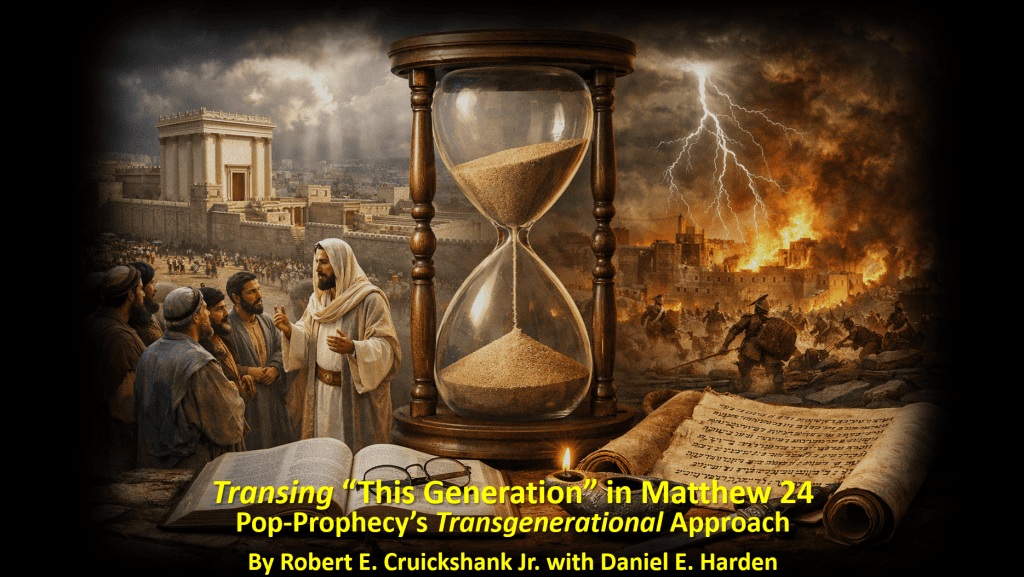
Transing “This Generation” in Matthew 24: Pop-Prophecy’s “Transgenerational” Approach
By Robert E. Cruickshank, Jr. with Daniel E. Harden
Copyright © Robert E. Cruickshank, Jr. (January 26, 2026)
Daniel E. Harden (Editor)
All Rights Reserved
[10-Minute Read Time]
Prophecy punditry tries hard to complicate simplicity. A recent example is Peter Goeman’s attempt to argue that “this generation” (Matthew 24:34) doesn’t really mean the generation to whom Jesus was speaking. Instead, we’re told that this is a transgenerational term that is part of a transgenerational pattern being used in a transgenerational address. Ian Hicks made a similar argument, claiming that “this generation” referred to a “trans-historical people” rather than “a singular group identified in the New Testament.”[1] After all of this transing[2] of the verse, it would seem that Jesus’s simple words have been transitioned to the point of transcending what He actually said!
Goeman’s transgenerational hypothesis comes in the midst of a 4-hour long video titled The Preterism Paradox.[3] Goeman is a Professor of Old Testament and Biblical Languages at Shepherd’s Theological Seminary, and his YouTube channel gives the general public much solid, academic-level Biblical teaching. In most other areas, I would definitely encourage my readers to listen to, and learn from, what he has to offer. Like so many other great teachers, Goeman does a wonderful job with the Scriptures – just not the ones having to do with eschatology.
This being the case, the focus of this article is solely to examine the way in which Goeman amalgamates certain passages with Matthew 24:34 in order to arrive at this so-called transgenerational understanding of Jesus’s words.
Hopscotch Hermeneutics and High-School Homework
With that said, the steps he takes in making the transformation from this generation into the transgenerational generation involve pop-prophecy’s usual mix of hopscotch hermeneutics. It reminds me of a math problem I did for homework back in high school. It took me 20 steps, and a long time to solve it. Maybe even 4 hours? I can’t remember. Once I was finished, I was sure I had the right answer – after that painstaking and grueling process!
Then came the homework review on the chalkboard the next day. As it turned out, not only did I have the wrong answer, but it actually only took 3 steps to solve the problem and get the right answer.
The multiple steps involved in making “this generation” into a transgenerational generation are similar to my attempts to solve the high school math problem.
What looks impressive in complexity often collapses in the face of simplicity.
Gimme Three Steps, Gimme Three Steps, Mister[4]
In modern terms, transing something involves several steps in the transing process.[5] Accordingly, there are several steps involved in the transitioning process of turning “this generation” in Matthew 24 into the transgenerational concept the prophecy pundits are looking for.
It’s not easy to follow, but I’ll do my best to simplify the complexity.
In the course of his 4-hour video, Goeman courses his way through a lot of passages. Learning my lesson from the high-school math course, I’ll just single out three of those passages in Goeman’s multi-step process. Anyone familiar with pop-prophecy will recognize the pattern immediately.
Typical of this approach, we’re taken on a road trip to other parts of the Bible to steer past what Jesus plainly said. Step one: we accelerate to the end of the Bible (Revelation 1). Step two: we throw it into reverse and land somewhere close to the beginning of the Bible (Deuteronomy 32). Step three: this detour is then somehow necessary to understand what “this generation” really means (Matthew 24).
By the end of the ride, I must admit to a bit of mental whiplash as Goeman took the wheel.
Buckle up.
How “Near” Gets Reengineered
Jesus said that “all these things” would fall upon “this generation” (Matt. 24:34), and John said “the time is near” in the book of Revelation (Rev. 1:3). This implies that the events were “near” and would in fact transpire before the first-century “generation” passed away. That’s the problem for pop-prophecy. They want to be able to say that the passage is “talkin’ ’bout my generation, this is…my generation, baby.”[6]
Consequently, they try to redefine Jesus’s words by rerouting away from those words. Then, they can retrofit His words with a supposed alternate meaning of “this generation.” In a nutshell: they redefine “near” so they can redefine “this generation.”
Goeman begins this process by taking issue with the normal understanding of the word “near” in Revelation 1:3, pointing out that it’s also used in Deuteronomy 32:35 – “the day of their calamity is near.”[7] Supposedly, “near” doesn’t really mean “near” here because the events of which Moses spoke weren’t really “near.” Goeman puts it this way:
“So, the day of their calamity is at hand, and their doom comes swiftly. So, again, the same kind of concept of now, now he’s not saying in Deuteronomy 32 that I’m going to punish them within the next couple years. You might be inclined to think that, but he’s actually talking about the far future when he’s going to enact punishment upon Israel for their transgressions. Okay? So, same kind of concept there. The day of their calamity is at hand. Well, does that mean it’s going to happen within the next couple years? No, it doesn’t. Okay? No, this terminology does not mean that it has to happen immediately.”[8]
Deuteronomy 32 is often referred to as The Song of Moses, which Goeman says “is kind of a prophetic template,”[9] and is one of a “lot of descriptors which point to a qualitative understanding of generation.”[10] Saying, “a qualitative understanding of generation,” is another way of saying “transgenerational.” Either way, “generation” is being used in a way that detaches it from its simple definition.
To boil it all down: the basic idea is that “generation” doesn’t refer to a specific people existing within a specific frame of time, but a specific type of people existing throughout all time. Putting it all together, Goeman says, “This fits very well with what I would call the transgenerational ‘you’ pattern of prophecy.”[11]
So, to sum it up: “near” didn’t mean “near” in Deuteronomy 32:35, which means that “near” doesn’t mean “near” in Revelation 1:3, and it’s all part of the transgenerational pattern of prophecy. And this “pattern of prophecy” somehow indicates that “this generation” doesn’t really mean “this generation” in Matthew 24:34. Convoluted reasoning? Absolutely. Ironclad proof? Hardly.
Hence, my opening line: Prophecy punditry tries hard to complicate simplicity.
So, sit down and take a deep breath if you’re dizzy.
The Calamity of Deuteronomy – Near or Far?
Now that you’ve caught your breath, let’s take a closer look at the starting point for Goeman’s argument. The whole crux of Goeman’s point with Deuteronomy 32:35 is that the fulfillment of this verse is in “the far future” and not within “the next couple years.” While it is true that the fulfillment didn’t come in “the next couple of years,” it didn’t wait until the “far future” either. In fact, it didn’t take all that long, and the book of Judges echoes Moses’s song:
“Then the sons of Israel did evil in the sight of the LORD and served the Baals, and they abandoned the LORD, the God of their fathers, who had brought them out of the land of Egypt, and they followed other gods from the gods of the peoples who were around them, and bowed down to them; so they provoked the LORD to anger. They abandoned the LORD and served Baal and the Ashtaroth. Then the anger of the LORD burned against Israel, and He handed them over to plunderers, and they plundered them; and He sold them into the hands of their enemies around them, so that they could no longer stand against their enemies. Wherever they went, the hand of the LORD was against them for evil, as the LORD had spoken and just as the LORD had sworn to them, so that they were severely distressed” (Judges 2:11-15).
Compare this statement in Judges with Goeman’s pivotal verse in Deuteronomy, which he treats like a smoking gun:
“Vengeance is Mine, and retribution, In due time their foot will slip; For the day of their calamity is near, And the impending things are hastening upon them” (Deuteronomy 32:35).
Taking Judges 2:11-15 and Deuteronomy 32:35 side-by-side, it clearly appears that “the day of their calamity” had indeed come upon them, and the Lord’s “vengeance” and “retribution” was being poured out. This, in fact, isn’t the only place where the book of Judges sings Moses’s tune.
And this shouldn’t surprise us, because in his statements leading up to the song, Moses says that “even today while I am yet alive with you, you have been rebellious against the Lord. How much more after my death! … For I know that after my death you will surely act corruptly and turn aside from the way that I have commanded you.” (Deut. 31:27-29) He goes on to tell them that they would provoke God to anger because of their evil. Moses is clearly speaking about the time that would follow shortly after his death. This isn’t a “transgenerational you,” as Goeman puts it – the “you” are the people Moses is talking to!
Accordingly, the language of Judges bears a strong affinity to that of Deuteronomy 32, and the lyrics of Moses’s song come blasting through.
The parallels are unmistakable.
Deuteronomy 32 and the Book of Judges
Looking back at the sins of the previous generation that portend the sins of the next generation, Moses says, “They have dealt corruptly with Him” (Deut. 32:5), a statement that refers back to Deut. 31:27. Accordingly, we’re told that the generation at the time of the Judges was “more corrupt than their fathers, going after other gods” (Josh. 2:19).[12]
Moses says that Israel “forsook the God who made him” and “made Him jealous with strange gods” by sacrificing to “demons” (Deut. 32:15). In like manner, the Israelites in Judges are told, “You have forsaken me and served other gods; therefore I will deliver you no more” (Judg. 10:13).[13]
In Deuteronomy 32:16, God is “provoked to anger” because of their “abominations.” In Judges 2:20, the “anger of the Lord” burns against Israel because they’ve transgressed His covenant.”
In Deuteronomy 32:17, the Israelites serve “new gods who came lately.” In Judges 5:8, Deborah sings, “Until I arose, as a mother to Israel, new gods were chosen.”[14]
Moses said the previous generation “forgot the God who gave you birth” (Deut. 32:18). Similarly, the generation in Judges “forgot the Lord their God, and served the Baals and the Asheroth” (Judg. 3:7).[15]
The time of fulfillment for the words of Deuteronomy 32:35 was indeed “near,” and parallels at the time of Judges are transparently clear.
Time…The Past has Come and Gone[16]
In Goeman’s pivotal verse, Moses says, “Vengeance is mine, and recompense, for the time when their foot shall slip” (Deut. 32:35). The Hebrew word here is ‘eth – simply meaning “time” and sometimes carrying the idea of “the time of an event.”[17] The Septuagint (LXX) translates this word with the Greek word kairos, which also carries the general idea of “time” with the nuance of an “appointed time” in some instances.[18]
This leads some to conclude that Moses’s words here are eschatological and for the far-distant future, i.e., the end of time. A perusal via Google will turn up results claiming that Deuteronomy 32 is about “Israel in the end-times”[19] or even “a great cosmic battle.”[20] Beginning in chapter 30, this whole section is supposedly “What Moses Teaches Us About End Times,”[21] and is even among the presumed “prophecies” which “specifically refer to volcanoes” and other “catastrophic events leading up to Christ’s second coming.”[22]
But Moses isn’t talking about the end times, volcanoes, a great cosmic battle, or even the Second Coming of Christ. And nothing about the use of the words ‘eth in Hebrew or kairos in Greek (LXX), in Deuteronomy 32:35, necessitates an eschatological context nor severs the link between the Song of Moses and the book of Judges.[23]
In Judges 4:4, we’re told that “Deborah, a prophetess, the wife of Lappidoth, was judging Israel at that time.” The word for “time” here is eth in the Hebrew Bible and kairos in the LXX – just as in Deuteronomy 32:35. The same is true of Judges 10:14, where God says, “Go and cry unto the gods which ye have chosen; let them deliver you in the time (Hebrew: eth, LXX: Kairos) of your tribulation.” The time of their turning to new gods and incurring the anger of God – as well as the time of their tribulation – had indeed come.
In spite of all of this, Moses says that the Lord will nevertheless have “compassion on His servants” (Deut. 32:36). In Judges 2:18, “The Lord was moved to compassion when he heard their groaning because of those who afflicted and beat them.”[24]
So, the “time” that was “near” in Deuteronomy 32 brought judgment to the Israelites in the book of Judges. But it was also a time of mercy and “compassion” when they reoriented themselves back to Him and turned away from the false religions that led them astray. Again, all of this highlights the clear contextual parallels between Deuteronomy 32 and the book of Judges.
Moses’s Song, Judges’ Reality
Judging from the book of Judges then, it would appear that the fulfillment of Moses’s words was indeed “near” when he spoke those words. In short, Deuteronomy 32:35 was not pointing to some distant transgenerational future, but to a judgment that came swiftly in Israel’s own history. Moses’s whole point was that the next generation would repeat the sins of the previous generation, and they did. What Moses foresaw as “near” was, in fact, fulfilled in the book of Judges.
In short, Deuteronomy 32:35 doesn’t somehow redefine the meaning of “near” in Revelation 1:3, and none of this redefines what Jesus meant by “this generation” in Matthew 24:34. Moses was addressing his words to “the generation to come” (Deut. 29:22) who would “act corruptibly” after his death (Deut. 31:29). In the same way, Jesus was addressing the generation of His day – the generation who’d see His words come to pass before they all passed away (Matt. 24:34).
Moses’s words rang true on the pages of Judges’ history, and Jesus’s words came true in the events of AD 70.
Transitioning Back to Simplicity
In an age of transing everything into something it’s not, let’s not trans Jesus’s words into something they’re not. Let’s not turn plain words into puzzles. Let’s not turn meaning into enigma.
The lesson?
When you spend more time on a homework problem than you need to, analysis paralysis sets in and often results in the wrong answer. “Near” means “near,” “this generation” means “this generation,” and clarity should not be traded for complexity.
There’s no need to complicate what God made simple, and there’s no need to turn “this generation” into a transgenerational riddle.
___________________________________________________________________________________________________________________________________________
[1] For an exegetical response to Ian Hicks, see: Gary DeMar, Is “This Generation” Past or Future? – The American Vision https://bit.ly/49Kf2UV
[2] “Transing is a new term and a meta-concept that aspires to capture all the bridging that is needed to cope with all the dynamics of modern day change. It identifies and describes the physical, emotional, social and cultural phenomena of various change processes that appears to be occurring in almost every facet of contemporary life. In such an environment our ability to adapt to change will determine the winners and the losers in every profession” (Transing, Living in the age of multi-level change | International Council of Design https://rb.gy/qxom0g )
[3] The Preterism Paradox | Christian Video Vault (YouTube) https://tinyurl.com/3h8m5mwd
[4] From Lynyrd Skynyrd, Gimme Three Steps (Lyrics) https://rb.gy/3zt4oc
[5] See: “The Transing Process” in Transing, Living in the age of multi-level change
[6] From My Generation, by The Who https://tinyurl.com/5e6c56bx
[7] The word for ‘near’used in Revelation 1:3 is ἐγγύς (transliterated as either eggus or engys). It is an adverb used to indicate that something is close in either time or location. The Hebrew word (qārôḇ) in Deuteronomy 32:35 is translated in the Greek Septuagint as the same word ἐγγύς.
[8] The Preterism Paradox, 1:35:53 – 1:36:18 ; emphasis added.
[9] The Preterism Paradox, 1:12:06 – 1:12:14
[10] The Preterism Paradox, 1:09:21 – 1:09:28
[11] The Preterism Paradox, 1:17:26 – 1:17:31
[12] The Hebrew word in both cases is sha’ chat ‘to corrupt, to ruin’ (H7843)
[13] The Hebrew word in both cases is na’ tash ‘to leave, to forsake’ (H5203)
[14] The Hebrew word in both cases is cha’ dash ‘new’ (H2319)
[15] The Hebrew word in both cases is sha’ khach ‘to forget’ (H7911)
[16] From Time by Hootie and the Blowfish https://tinyurl.com/3ra43err ; I am indebted to Daniel E. Harden for his work on the use of kairos in the book of Judges (LLX) in this section of the article.
[17] Entry in STEP Bible (Tyndale House)
[18] Entry in STEP Bible (Tyndale House)
[19] Paul Macisker, Deuteronomy 32 | The End Time Bible Commentary https://tinyurl.com/4f7e4vmn
[20] The Great Cosmic Battle (Deuteronomy 32:25-29 and Revelation 19:11-16) – Part 5 | Zion Covenant Reformed Church https://tinyurl.com/2vv5r7tw
[21] The Last Days: What Moses Teaches Us About End Times | David S. Schrock https://tinyurl.com/36usrtn4
[22] John Ross Schroeder, What Does Bible Prophecy Say About Volcanoes? | United Church of God https://tinyurl.com/j52f77cn
[23] Other usages of kairos, in the book of Judges (LXX), that show that it is not a technical or eschatological term include: Judges 11:26, 12:6, 14:4, 21:14, 21:22, 21:24.
[24] Most translations use the word “pity” here in English. But it is the same Hebrew word in both cases, na’cham ‘to be sorry: comfort’ (H5162). The Message Bible (MSG) is among the transitions that render it as “compassion.”