
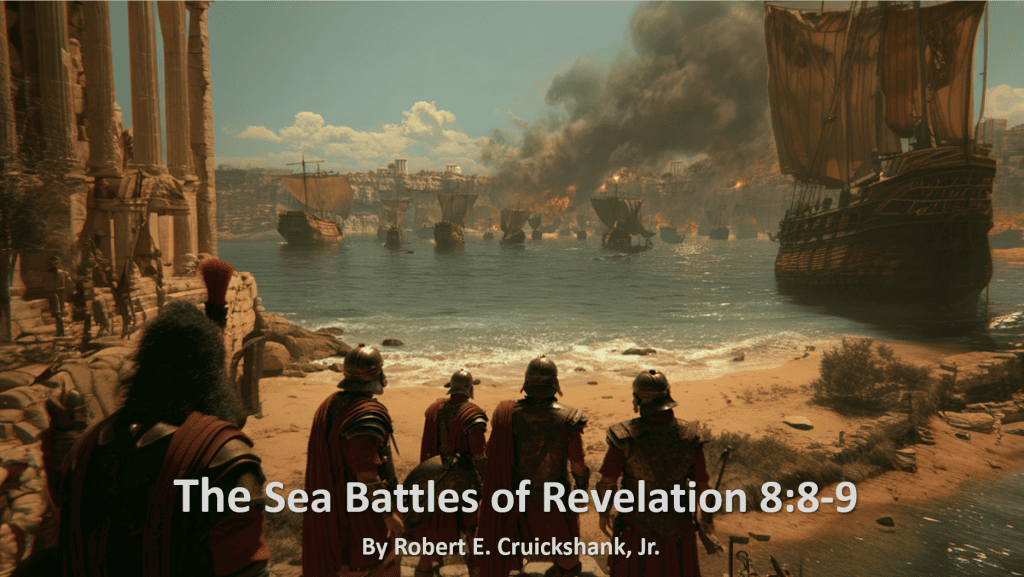
The Sea Battles of Revelation 8:8-9
By Robert E. Cruickshank, Jr. (March 25, 2026)
[4-Minute Read Time]
“…and a third of the sea became blood, and a third of the creatures which were in the sea and had life, died; and a third of the ships were destroyed” (Rev. 8:8b-9).
According to the pop-prophecy outlet Gateway Bible Studies, this passage is about “naval power, especially super nuclear submarines with ICBM launch capability,” and John is describing “the future of warfare.”[1] Specifically, John is supposedly describing the havoc to be caused by “Russian Typhoon class nuclear subs,” which “are the largest, fastest, stealthiest, deepest diving and deadliest in the world.” According to the article, “Each one carries as standard ordinance 20 ICBMs with 10 warheads each,” that “can turn 200 large cities into vast devastated cemeteries.”
One has to wonder why the seven churches of Asia Minor, in the first century, needed to know about Russian submarines carrying warheads in the twenty-first century? Or, more to the point, why would they care? What possible relevance would nuclear war, 2000 years down the road, have had for them?
On the other hand, the threat of nuclear war is extremely relevant today. And the idea that the Bible supposedly predicts nuclear war is even more relevant. As believers, we should be against the proliferation of nuclear weapons and working toward the goal of the nations once again beating their swords into plowshares and learning war no more (Isa. 2:4; Mic. 4:3).
But if nuclear war really is the prophetic and inevitable outcome of mankind in the end, then we’re kicking against the prophetic goads trying to prevent the inevitable end.
This causes believers to be complacent.
After all, this is what’s supposed to happen in the “last days” right? So, go ahead and “build those missiles, aim em high, build those missiles, aim em low.”[2] This all means that the Rapture is coming, and we’re soon to go!
This is precisely the danger of misinterpreting prophecy and ignoring history.
In reality, Revelation 8:8-9 has nothing to do with our time and everything to do with John’s own time.[3] As Ken Gentry writes, the imagery in these verses “involves a historical component reflecting the deadly sea battles on various bodies of water during the Jewish War.”[4]
Shipwrecks at Joppa
Josephus speaks of a great number of Jews who had escaped out of the demolished cities of Judea while Vespasian was in Caesarea. These Jews decided to flee to Joppa, which had been left desolate by Cestius, as “a place of refuge.”[5]
Joppa was a port city about 35 miles northwest of Jerusalem, and 30 miles south of Caesarea. It’s where Peter was when he raised Tabitha from the dead in Acts chapter 9 (Acts 9:36-42), and it’s where Jonah fled when the Lord told him to go to Nineveh. He went to Joppa so he could get on a boat and sail away (Jon. 1:1-3).
As we all know, things didn’t go well for Jonah there. A great storm came and “the ship was about to break up” (Jon. 1:4). Much the same happened to these first-century Jews who fled to Joppa.
Because the “region had been” so “laid waste in the war, and was not capable of supporting them,” Josephus says, “they determined to go off to sea.” Josephus then says that they built numerous small ships and turned to piracy along the coasts of Syria, Phoenicia, and Egypt. Basically, they tried to survive by seizing the goods and resources of other ships and then return to their safe haven in Joppa.
When Vespasian got news of this, he sent troops to attack the city by night.
When his forces arrived, the Jews in Joppa fled to their ships and anchored offshore. But at dawn, a violent “north wind” arose, driving their vessels against one another and onto the sharp rocks, destroying them completely.
Thousands perished by drowning or shipwreck, some even taking their own lives, until the sea was red with blood and the shore was littered with corpses. Josephus describes the ships being dashed to pieces against the rocks, and he even says “a great many were embarrassed with shipwrecks.”
His description here, of the massive shipwrecks and bloody sea off the coast of Joppa, reads like a commentary on Revelation 8:8-9.
Trouble at Sea off the Shores of Capharnaum
Josephus speaks of a similar instance, which took place in a lake off the shores of Capharnaum. He says that the Jews’ “ships were small and fitted only for piracy,” and “they were too weak to fight with Vespasian’s vessels.”
According to Josephus, the Jewish pirates would try to get close enough to Vespasian’s ships so they could throw “stones at the Romans.” This resulted in the Romans leaping onto the Jews’ ships, with swords in hand, slaying them, and destroying their ships.
He said that Vespasian’s forces “encompassed them about the sea,” with the result being that “one might then see the lake all bloody, and full of dead bodies, for not one of them escaped…The number of the slain, including those that were killed in the city before, was six thousand and five hundred.”
All of this echoes what John said in Revelation: “…and a third of the sea became blood, and a third of the creatures which were in the sea and had life, died; and a third of the ships were destroyed” (Rev. 8:8b-9).
Reading Revelation Responsibly
Revelation 8:8-9 is not a prophecy about modern nuclear warfare or futuristic submarines—it is a vivid reflection of first-century events, particularly the deadly naval conflicts during the Roman-Jewish War.
John’s imagery of blood-red seas, dying creatures, and destroyed ships points directly to historical episodes, such as the catastrophic shipwrecks at Joppa and the battles on the lake near Capernaum, recorded by Josephus.
The sea battles of Revelation 8 are not our battles to fight, and we need to fight the battle against the threat of nuclear weapons in the hands of mankind today, not reinforce it by teaching that the Bible somehow predicts it.
__________________________________________________________________________________________________________________________________________________
[1] Revelation Chapter 8 | Gateway Bible Studies https://bit.ly/4dIkREu
[2] REZ BAND – ARMAGEDDON APPETITE LYRICS https://bit.ly/4oQEuwt
[3] For a recent sermon contrasting the views of Gary DeMar and Hal Lindsey on Revelation 8, see: Dave Hentschel, The Seven Trumpets of Judgment: Preterist vs. Futurist Interpretations (Revelation 8:6-11:19) | Millington Baptist Church https://bit.ly/4syd8xi
[4] Kenneth L. Gentry, Jr., The Divorce of Israel [Vol. 1], 762.
[5] All of the information on these sea battles, in this article, can be found in Josephus, Wars, 3.9.1 – 3.10.9