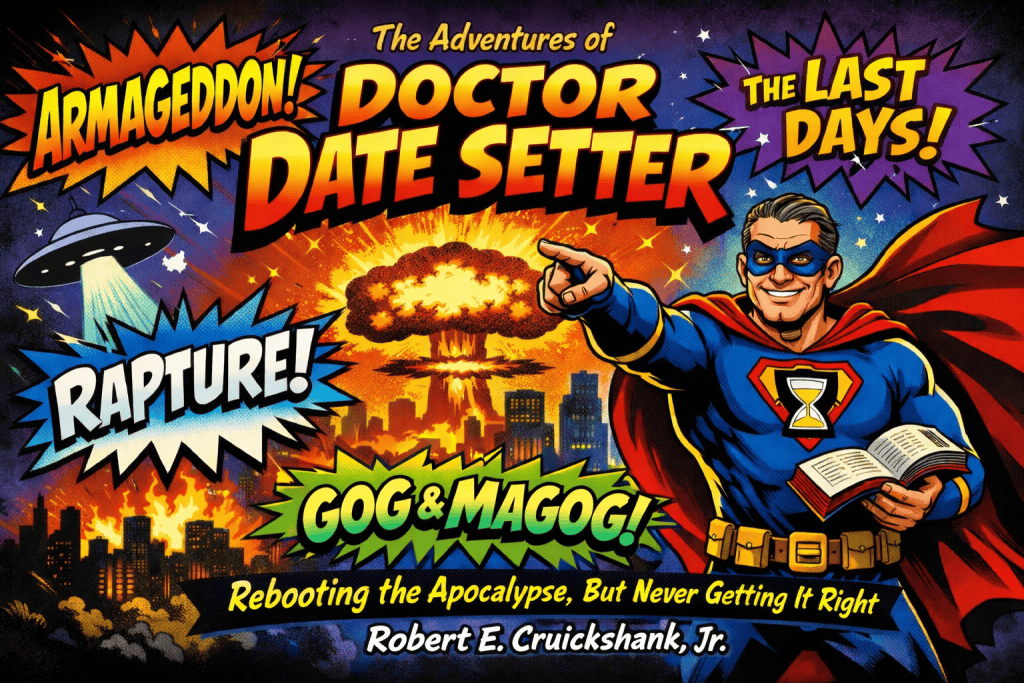
The Adventures of Doctor Date Setter: Rebooting the Apocalypse, But Never Getting It Right!
By Robert E. Cruickshank, Jr.
Copyright © Robert E. Cruickshank, Jr. (February 5, 2026)
Daniel E. Harden (Editor)
Brett Prieto (Proofreader)
All Rights Reserved
[10-Minute Read Time]
“A hero can be anyone. Even a man doing something as simple and reassuring as putting a coat around a little boy’s shoulders to let him know that the world hadn’t ended.”
-Bruce Wayne, (The Dark Knight Rises)[1]
In the Olivet Discourse, Jesus famously said, “Truly I say to you, this generation will not pass away until all these things take place” (Matthew 24:34). In The Late Great Planet Earth, Hal Lindsey famously said, “A generation in the Bible is something like forty years. If this is a correct deduction, then within forty years or so of 1948, all these things could take place.”[2]
Later, Lindsey was asked, “But what if you’re wrong?” To which he replied: “Well, there’s just a split second’s difference between a hero and a bum. I didn’t ask to be a hero, but I guess I have become one in the Christian community. So, I accept it. But if I’m wrong about this, I guess I’ll become a bum.”[3]
After Lindsey’s death, Matthew Avery Sutton observed: “Lindsey is gone, but the ideas he popularized will continue to shape evangelicalism for generations to come.”[4]
This has proven true.
Lindsey’s Lasting Legacy
As Ian Paul writes, “Many Christians still think that the rapture and the seven-year tribulation are clearly taught in the Bible, that we are in the end times in our era, and that the Book of Revelation is a terrifying prediction of events that are happening in our day.”[5] Hal Lindsey published his runaway bestseller, The Late Great Planet Earth in 1970.[6] It was “an incredibly successful ‘crossover’ book—one of the first texts to bridge the divide between religious and secular audiences.”[7] It was also part of a push, on the part of Christian publishers, to attract the “youth market” and make the Apocalypse “a popular concern.”[8]
It’s been 56 years since Linsey’s paperback hit “hit” the shelves in bookstores everywhere, and that targeted youthful audience is now well into middle age and retirement.
Lindsey’s projected Doomsday date was 1988, 40 years after Israel’s rebirth in 1948. He called the decade of the 80s the Countdown to Armageddon. But the children of the 80s seemed to have lived past the countdown and survived Armageddon. As it turned out, his prediction didn’t pan out. Unless you buy into The 1988 Anomaly Theory,[9] that year came and went without an apocalyptic trace.
By all rights, his own failed predictions have proven Hal Lindsey to be a “bum” – by his own admission. For all too many, however, he was and is still a “hero.” He always managed to maintain a sizable following, and his apocalyptic playbook survives The Late Great Hal Lindsey to this day. Despite this “hero’s” 100% failure rate, his failed theology continues to dominate and permeate.
Today, a whole new generation has become the coveted youthful audience of those who choose to propagate his views.
Doomsday Deadlines and Lasting Legacies
In my previous article, I talked about the Doomsday Indoctrination currently streaming on social media and said, “What today’s young people don’t realize, however, is that everything they’re being fed in their feed is merely the recycled mess of the failed predictions of yesterday.” Predictions about the Beast, the Antichrist, and Gog & Magog have been endlessly rebroadcast, rerun, and reimagined. There’s nothing new under the sun (Eccl. 1:9)…or under the chemically strengthened glass of your phone’s screen.
It’s all been said before, it’s all been done before, and it’s all been premiered before – even at the box office. Take, for example, movies like A Thief in the Night, Left Behind, and The Omega Code. Just to name a few.
But for today’s brand-new audience, the idea of the impending end of the world is all being repackaged – complete with updated identities, upscaled features, and upgraded special effects. The new version just keeps rolling as our fingers keep scrolling.
“The END,” it seems, is never-ending.
Rebooting the Apocalypse
In this sense, the new prophecy predictions are like theatrical reboots in an end-times cinematic universe.
Consider, by way of analogy, all the incarnations of Batman over the years. The stories are similar, but never quite the same. Additionally, amidst all the variations, none are ever completely true to the original comic books. With each new reboot, new actors are recast for the role of the hero and the villain alike.
In the same way, new pundits are routinely recast for the role of the latest prophecy hero, and new world leaders are constantly rebranded as the new end times villains (see: Here, here, here, and here). The stories are similar, but never quite the same, and never true to the original screenplay (i.e., the Bible). New dates are set for the Apocalypse, and the script is constantly updated and upgraded (see: here).
With that said, Hal Lindsey was arguably the first well-recognized prophecy pundit of our modern era. In the quotation above, he said this made him a “hero” in “the Christian community,” although he didn’t “ask” to be one. Modestly spoken like a true “hero!”
Of course, every true “hero” needs an alias hero-name. After all, when he put the cape on, Batman didn’t go by Bruce Wayne. And of course, in real life Bruce Wayne wasn’t really Bruce Wayne but merely the actor who played him. In any good superhero movie, someone needs to play the part and stand in the spotlight of fame.
Enter: Doctor Date Setter
Hal Lindsey, modest as he claimed to be, fit this role perfectly. He set the date, and made up the story. He branded it, he told it, and then he sold it. In our modern era, he was the original Doctor Date Setter.[10] He was also the pop-prophecy pace setter, with others following closely behind – hoping to sell it even better. In this sense, then, Lindsey was like Lewis Wilson – the first onscreen Batman.[11]
Giving Lindsey a run for his money, early in 1988 Edgar Whisenant also auditioned for the starring role with his 88 Reasons Why the Rapture is in 1988.[12] But because it came in late, his book didn’t quite go over as great.[13] In this sense, Whisenant was more like Robin than Batman – just a sidekick. They might have been a Dynamic Duo, but Lindsey remained the frontman of the show.
But no show goes on forever.
Lewis Wilson’s 15-episode Batman serial[14] eventually ran its course. Then, other versions of the Caped Crusader incarnated themselves in the decades to follow, with other actors stepping into the role. It was much the same in the early days of American Pop-Prophecy. Just as Adam West, Michael Keaton, Val Kilmer and others eventually stepped into the Dark Knight’s shoes, many aspiring new pundits tried their hand at being the next end-times guru.
And it didn’t take long.
Quick to Cash In on the Action
Just like a studio quick to cash in on the success of a good action movie with thrilling sequels, other prophecy pundits wanted a piece of Hal Lindsey’s action. As such, the following years rolled out more and more apocalyptic attractions. Matthew Avery Sutton chronicles the highlights from the 70s to the 90s:
“Other evangelicals followed Lindsey down the road to Armageddon. They kept readers up to date with analyses of the unremitting global turmoil and chaos that defined their eras. San Diego minister Tim LaHaye laid out an argument in 1972 for an imminent second coming in ‘The Beginning of the End.’ Two years later Dallas Theological Seminary President John F. Walvoord published ‘Armageddon, Oil and the Middle East Crisis.’ In 1972, apocalypticism found another innovative expression in the film ‘A Thief in the Night,’ which became a cult classic. Christian rock pioneer Larry Norman’s track ‘I Wish We’d All Been Ready’ (for the Rapture) haunts the film. Even Billy Graham got in on the action, writing more books on the end times than on any other topic. More recently, LaHaye and co-author Jerry Jenkins wove premillennialism into fiction in their bestselling, 16-volume ‘Left Behind’ series.”[15]
The trend continued throughout the 2000s and right up to our own time today. Like a blockbuster franchise that keeps rolling out the sequels, prophecy punditry found new ways to repurpose and repackage the end-times formula for a fresh audience.
Hal Lindsey himself was back in action with revised editions of The Late Great Planet Earth and other spin-offs. Expectedly, Mockbusters and knockbusters soon followed. Hopeful Lindsey wannabes like John Hagee, David Jeremiah, and Joel Rosenberg raced to interpret every war, every natural disaster, and every new Mid-East headline as a harbinger of the end times. Tim Lahaye finally jumped on the bandwagon and left the rest behind. His series continued to expand its cinematic universe through films, graphic novels, and tie-in merchandise like nothing before or since.
Which brings us to today.
Newsfeed Exegesis
The rise of social media and digital access platforms has created a new arena for all of this Doomsday Indoctrination. YouTube channels, TikTok clips, and streaming video now decode current events in real time and foster new fears of being left behind. Like a continuous loop that never quits, an endless algorithm of end-times sensation endlessly reinforces the latest prophetic speculation.
For example, a popular reel from End Time Inc declares, “We use current events to show how these prophecies are coming to pass right now, letting us know we are just prior to the Second Coming of Jesus Christ and the Battle of Armageddon.”
The problem is that Hal Lindsey, Tim LaHaye, John F. Walvoord, Billy Graham, and the rest all used “current events to show how these prophecies” were “coming to pass” right then, back in the 70s, the 80s, and the 90s. But they were wrong. All of them. They weren’t even in the ballpark. Those decades have come and gone with no Second Coming and no Battle of Armageddon. No world war, no tribulation. Nothing even close to what they predicted.
Pop-prophecy has a perfect record, a 100% failure rate. And the losing streak isn’t going to break, so long as they use headlines as their guide. At the end of the day, however, the prophecy pundits are not the real losers here.
Case in point: Hal Lindsey ended up doing pretty well for someone who turned out to be a “bum.” So too, the actors playing Doctor Date Setter today will do well for themselves, as well. They’ll continue to increase their subscriber numbers, their view counts, and their Patreon accounts. It’s the kids who are watching the reels who really lose out. They will grow up in a world thinking that there won’t be a world for them to grow up in.
They will be like Larry Norman, the grandfather and pioneer of Christian Rock. As Fred Clark says, “Larry Norman truly believed what he learned from Hal Lindsey. And what he learned from Hal Lindsey wasn’t true. And that turned his whole world upside down.”[16] Lindsey, on the other hand, was described by Publishers Weekly as an “Apocalypse evangelist who sports a Porsche racing jacket and tools around Los Angeles in a Mercedes 450 SI.”[17]
While Lindsey and Norman are both examples to the extreme, the course of each of their lives highlights the divide between the prophecy pundits and those who follow their teachings. In fact, it brings it into sharp focus. Clark puts it well:
“Like most such ‘Bible-prophecy scholars’ — and unlike many of their followers — Lindsey managed his money well. Most of these unexpectedly, contradictorily long-lived Rapture preachers invested wisely and practiced the kind of long-term responsible financial planning that all of their teaching insisted was unnecessary if anything they were saying was true.”[18]
The question for us today is whether we are going to continue with this trend or bring it to a long overdue end? When will the consecutive string of failed predictions finally provoke us to put our foot down and say, “Enough!”? How long will it take before we stop repeating their mistakes?
Where to Go from Here
Hal Lindsey is gone, but his legacy lives on. Doctor Date Setter is recast and rebooted with a simple click of the mouse or touch of the screen. With each new generation, a new group of prophecy pundits steps into the role, believing they’ve finally cracked the code. They recycle the same misread texts, trying to retrofit them into newer and more current events. The younger generation has no idea they’re watching a remake of an old movie. The older generation has a responsibility to make sure we “don’t get fooled again.”[19]
The truth is that the parents and grandparents of today are the ones who sat through the movie’s original showing in the days of yesterday. That’s a lot of time gone by to study the key Scriptures involved and figure out what they’re actually talking about!
These parents and grandparents should know by now that the original movie wasn’t even good in the first place. They should know by now that the reboots, along with the new cast of characters, aren’t handling the Scriptures any better than the original actors. They should know by now that all the reboots in the world can’t make a bad script any better.
We need to get familiar with the original script, the real script, the true script of the Scriptures.
Ending Credits
We all have a responsibility to handle God’s Word accurately (2 Tim. 2:15) and steer others clear of the secret decoder ring approach of pop-prophecy (2 Pt. 1:20). Here at Cruickshank’s Corner, as well as other outlets such as American Vision, believers have access to materials and resources that can help them do just that.
The new pop-prophecy cast is always assuring the new generation that they’ll finally get it right at last. But the Apocalypse doesn’t need another reboot. Doctor Date Setter doesn’t need another reshoot. And the prophecy pundits don’t need another chance to regroup.
The old film has played long enough. It promises each generation that “the end” is about to roll, but the ending credits never scroll. It’s time to stop funding the sequel. It’s time to shut down the franchise. It’s time to put a different movie up on the screen – one that is true to the original Gospel message, rather than one that is retrofitted into decades of failed predictions based on today’s headlines.
Let’s make this date, today’s date, the final curtain call for Doctor Date Setter.
______________________________________________________________________________________________________________________________________
[1] The Dark Knight Rises “A hero can be anyone” | YouTube https://tinyurl.com/3s6b2tvw
[2] Hal Lindsey, Are We The Final Generation? | The Hal Lindsey Report https://tinyurl.com/yxsymuj7 ;
see Lindsey, The Late Great Planet Earth (1970) pg 43, in chapter 4, titled “Israei, O Israel”. Lindsey, in talking about Israel and “this generation” in Matt. 24:34, says “What generation? Obviously, in context, the generation that would see the signs – chief among them, the rebirth of Israel.” But Matt. 24 says nothing about any rebirth of Israel. Lindsey assumed this based on his erroneous interpretation of the parable of the fig tree in verses 32-33. But not even the fig tree in the parable goes through a rebirth. Nor does Scripture ever use a fig tree as a representation of the nation of Israel.
[3] Q: One Wrong Step Messes Up Your Eschatology (August 18, 2022) | American Vision https://tinyurl.com/4jxvv7wj
[4] Matthew Avery Sutton, The late great Hal Lindsey (December 5, 2024) | Religion News Service https://tinyurl.com/4w6354ds
[5] Rev. Dr. Ian Paul, Hal Lindsey (1929-2024): The End Times Theologian who Popularized the Rapture | Premier Christianity https://tinyurl.com/37rcks29
[6] The dirty little secret behind Lindsey’s book is that he ripped the whole idea off from another author. As Scot McKnight writes, “One noteworthy detail, which I mentioned above, is that two years earlier than Hal Lindsey’s famous book was Salem Kirban who wrote in 1968, Guide to Survival, a book designed for people who were not raptured and who wanted to make sense of the tribulation. And, in 1970 Kirban wrote a book called 666, later writing 1000. In effect, Lindsey capitalized on the book of Salem Kirban. And Larry Norman wrote “I Wish We’d All Been Ready” in 1969! Someone, I hope, has sought to show the relationship of Lindsey to his predecessors, especially Kirban” (Late, Great Dispensationalism | Scot’s Newsletter https://tinyurl.com/4ntvs8v9 ). So, Kirban really didn’t make any money (in comparison), and Lindsey capitalized off the thesis. Ironically, Kirban’s book came out in 1968, the same year that the relatively unknown band Spirit released their song Taurus, of which Led Zeppelin has been accused of plagiarizing for the signature song, Stairway to Heaven (see: Plagiarism case over Led Zeppelin’s Stairway to Heaven finally ends | The Guardian https://tinyurl.com/5df98bd4 ).
[7] Erin A. Smith, The Late Great Planet Earth Made the Apocalypse a Popular Concern | National Endowment for the Humanities https://tinyurl.com/52xwd7dr
[8] Smith, The Late Great Planet Earth Made the Apocalypse a Popular Concern
[9] The 1988 anomaly is an internet-driven theory suggesting a cataclysmic, undetected event occurred around 1988, causing a timeline split or a “reset” of reality. Proponents claim the world was replaced by an imperfect, simulated clone, often citing increased nostalgia, the Mandela Effect, and a feeling of societal decline since that era. See: Unraveling the 1988 Anomaly: A Groundbreaking Theory | Online Theories https://tinyurl.com/5n6th3pn ; The 1988 Anomaly Theory | James Carner https://tinyurl.com/68yxr8mx
[10] Just to be clear, though, Hal Lindsey was not the first to actually teach this type of interpretation. He actually followed in a line that stretched back over 150 years. He got his influence from earlier theologians such as John Darby, Cyrus Scofield, Dwight L. Moody, Charles Ryrie, and John Walvoord, to name just a few. Ryrie and Walvoord even taught at Dallas Theological Seminary, where Hal Lindsey graduated in 1970.
[11] The Batmen – Batman In Live Action | Batman on Film https://tinyurl.com/53ajy6rt
[12] For more on this, see: Gary DeMar, “Bubble Boy” Prophecy Speculation on YouTube (October 2, 2025) | American Vision https://tinyurl.com/mr2yp9sy
[13] 88 Reasons eventually sold eventually sold 4.5 million copies ( In God We Trust | Desert Stream https://tinyurl.com/y63wjpn9) while Late Great Planet Earth clocked in at over 28 million copies (The Late Great Planet Earth | https://tinyurl.com/yfhayptx). Whisenant wasn’t initially deterred when 1988 came and went without a rapture. He tried again in 1989 (The Final Shout: Rapture Report 1989, with 89 reasons this time), then again in 1993 (23 Reasons Why a Pre-Tribulation Rapture Looks Like it will Occur on Rosh-Hashanah 1993) and 1994 (And Now the Earth’s Destruction by Fire, Nuclear Bomb Fire, which he said would occur in 1994) before finally stopping.
[14] Lewis Wilson | Wikipedia https://tinyurl.com/2dpw4bfy
[15] The late great Hal Lindsey
[16] Fred Clark, Hal Lindsey is gone (the Late, Great Planet Earth is not) | Slachtivist (Patheos) https://tinyurl.com/yezheaf2
[17] Q: Smith, The Late Great Planet Earth Made the Apocalypse a Popular Concern
[18] Clark, Hal Lindsey is gone
[19] From The Who, “Won’t Get Fooled Again” https://tinyurl.com/3x343sxy