
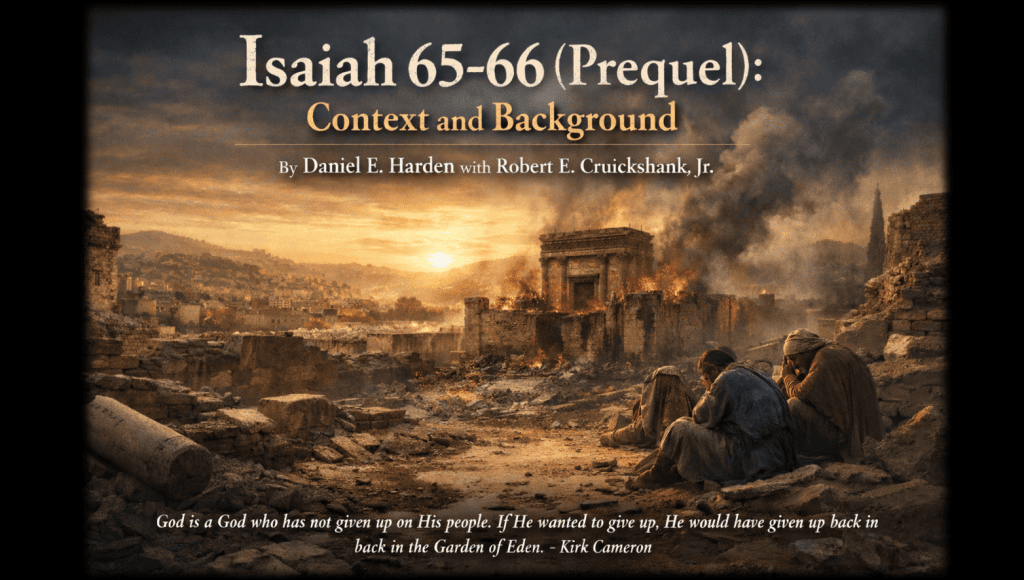
Isaiah 65-66 (Prequel): Context and Background
By Daniel E. Harden with Robert E. Cruickshank, Jr.
God is a God who has not given up on His people. If He wanted to give up, He would have given up back in the Garden of Eden. -Kirk Cameron
In our series of articles dealing with Isaiah 65-66 (start here), we made a close examination of the details in the prophecy to determine how they applied to the audience of Isaiah’s time. Upon close inspection, it became clear that there are numerous references to idol worship and pagan rites, something which had become widespread in Judah in the days leading up to exile.
In fact, idolatry was a defining characteristic of Judah specifically during that period of their history. For example, Isaiah refers to the worship of Gad and Meni (Isa. 65:11), the false gods of fortune and destiny in the ancient Near East.[1] Such references to false gods and idolatry all but disappear after the restoration.
But the question keeps popping up – if these chapters have to do with exile, then why is the exile not clearly mentioned?
Contextual Continuity
Toward this end, it is important to remember that the Scriptures were not originally in the format in which we so conveniently find them today. There were no chapter divisions. There were no verse numbers. When the original audience heard or read Isaiah’s words, there was no clear-cut division between the chapters and sections that we currently see. That was all added later for readers’ benefit.
When reading the last two chapters of Isaiah, it is important to remember that prophecies of Isaiah 65-66 didn’t appear in a vacuum. Nor is there a distinct linguistic indication separating these prophecies from what immediately precedes them, as is found in other places in Isaiah. By all appearances, what we consider as chapter 65 would have only been a continuation of the words found in chapter 64. In fact, seen properly, the opening of chapter 65 is actually a response to the pleas that appear at the end of chapter 64.
It is imperative, then, to glean the context that leads to God’s response in chapters 65-66 by taking a look at what prompted this response.
Allusions by New Testament writers
Context is not always easy, but it is generally discernible with careful diligence. It is important to view each passage in its own historical setting. According to Professor Richard L. Thomas, “every OT passage must receive its own grammatical-historical interpretation, regardless of how a NT writer may use it.”[2]
Thomas is correct when he urges us to take each Old Testament passage in context, letting each prophecy speak in its own historical setting. We need to guard against superimposing a system over a prophecy in order to determine its intent. When Joseph had a dream about his father and brothers bowing down before him (Gen. 37:9), that had a specific historical setting. When the Israelites were promised that they would be freed from Egypt and taken to the Land (Exo. 3:7-10), that had a specific historical setting. When the Israelites were told that they were going to be punished with exile for iniquity (Isa. 5:13; Jer. 13), that had a specific historical setting as well. Each Old Testament prophecy has its own historical setting.
Overlaying a first-century or end-time theme onto any of those prophecies would be inappropriate since it would blur or violate the details of the prophecy and compromise the message to the original audience.
The same is true in Isaiah 65-66. Don’t lose sight of the details of what is being said just to fit a conclusion. Pay attention to the details. Details are important, and Isaiah gives some very specific details about the iniquities oof God’s people – details that were specific to the time before the exile.
Thomas is not alone when he calls for a more careful examination of Old Testament prophecies and how they are used in the New Testament. Most theologians now realize that the way New Testament writers used Old Testament passages is often in the manner of a thematic application, and that attempting to find a one-to-one correlation between the original Old Testament passage and how it is used in the New Testament is generally inappropriate, inadequate or misleading.[3] It is the theme that is carried forward, not the details.
We need to remember this when looking at Isaiah 64. Some see Paul’s citation of Isaiah 64:4 in 1 Corinthians 2:9 as evidence that Isaiah is not dealing with the historical situation of his own time, and they warp-speed the passage directly to New Testament times, or even further. Such an attempt is a misapplication of Isaiah, robbing the text of its proper context and intent. As such, it represents a misunderstanding of the typical way the New Testament writers used the Old Testament. In fact, the fullness of the meaning of New Testament citations of the Old Testament can only be understood properly when the original intent and theme is taken into account.
The quintessential example is Matthew’s use of Hosea 11:1 in Matthew 2:15. Matthew shows us that the New Testament writers take the core theme or idea of the Old Testament text and bring it to life in a new situation at the time of Christ. The New Testament use of the Old Testament text doesn’t alter, change, or nullify the original context of the Old Testament passage. Thus, Professor Thomas is correct when he adds, “The OT must not receive multiple meanings by being read through the eyes of the NT.”[4] A good rule of thumb is to remember that revelation through Scripture is progressive, not regressive.
This principle is also true in Isaiah.
Reflecting on Paul’s use of Isaiah 64:4 in 1 Corinthians 2:9, James Rochford says, “In Isaiah 64, the Jews were being judged, and they were told to wait for God’s promise of redemption and rescue, which results in Isaiah 65:17 (i.e. the new heaven and new earth). In the same way, Paul is saying that Christians have to wait for God’s ultimate promise: heaven. While this isn’t a one-to-one fulfillment of prophecy, Paul is essentially showing a comparison between these events. For example, if you were counseling someone to wait on God for a spouse, you might quote them the story of Joseph, who had to wait years for years [Sic], while languishing in prison. While Joseph didn’t need to wait on a spouse, he still needed to wait on God. Paul is handling the OT text in the same way.”[5] The contexts are parallel, but they are not identical.[6]
Whenever a New Testament author alludes to an Old Testament passage, more often than not it is used as thematic application.[7] Each Old Testament passage must be considered first and foremost in its own historical setting.
With that said, let’s take a closer look at Isaiah 63-64, which frames the backdrop for Isaiah 65-66, in its own historical setting.
Iniquity
Isaiah 64:4 is not an isolated projection of Paul’s day. It is a general statement about the sovereignty of God, which Paul then relates to as still true in his time. It is part of the prayer of mercy that began in 63:15. It is clear in context that this is not meant as a projection:
Would that you would tear the heavens and come down;
the mountains would quake before you,
2 as fire kindles brushwood,
the fire causes water to boil,
to make your name known to your adversaries,
that the nations might tremble from your presence.
3 When you did terrible deeds which we did not expect, you came down;
the mountains quaked because of your presence.
4 And since ancient times they have not heard,
have not listened,
no eye has seen a God except you;
he acts for the one who waits for him. (Isa. 64:1-4)
The point of view presented in chapter 64 is that of Israel/Judah in exile and pleading for mercy. Isaiah has projected the prophecy ahead to the time (but in his near future) when punishment has been enacted. This is clear in Isaiah 63:
Your holy people took possession for a little while;
our adversaries have trampled down your sanctuary. (Isa. 63:18)
Any attempt to project this to any other time misses this detail, and compromises the importance to the original audience. In putting himself in the shoes of the exiles, he mourns:
“And we all wither like a leaf, and our iniquities take us away like the wind”(Isa. 64:6b).
He then repeats the fact that they are suffering as a result of their iniquity:
“And there is no one who calls on your name, who pulls himself up to keep hold of you, for you have hidden your face from us, and melted us into the hand of our iniquity.” (Isa. 64:7)
“You must not be exceedingly angry, Yahweh, and you must not remember iniquity forever!” (Isa. 64:9)
Here we see a repeated reference to the nation’s iniquity. The word translated ‘iniquity’ is ʿāôn (or ‘avon), which carries the connotation of committing a crime, the guilt incurred from that crime, and the punishment meted out for that crime.[8] The word is used over 230 times in the Old Testament and applies to a variety of infractions in various contexts, particularly on the part of Ancient Israel. Rather than jumping to unrelated texts, we need to determine specifically and contextually what Isaiah has in mind here when he refers to iniquity. To best determine this, the best place to look for an answer is in the book of Isaiah itself.
Isaiah uses the word from the very beginning. In his opening argument as prosecutor[9], Isaiah asserts that Israel is guilty:
“Ah, sinful nation, a people heavy with iniquity (ʿāôn) , offspring of evildoers, children who deal corruptly. They have forsaken Yahweh; they have despised the holy one of Israel. They are estranged and gone backward” (Isa. 1:4).
In his closing argument, Isaiah not only reiterates this, but he also summarizes just what these iniquities are.
“Your iniquities (ʿāôn), and the iniquities (ʿāôn) of your fathers together, saith the LORD, which have burned incense upon the mountains, and blasphemed me upon the hills: therefore will I measure their former (ri’šôn) work into their bosom. (Isa. 65:7)
Isaiah is quite clear. The specific iniquities (ʿāôn) for which the Israelites were on trial were the crimes of worshiping other gods on the mountains and insulting the true God with their pagan offerings on the hills. These iniquities are the “former (ri’šôn) things” that would not be “remembered” once they returned from exile and Jerusalem was restored in the restructured “new heavens and new earth” (Isa. 65:17-18).
The reference to the mountains and hills summarizes the grievances that have been spelled out throughout the book of Isaiah. Just before this summarization, Isaiah mentions sacrifices “offered in gardens and orchards,” a reference to pagan rituals practiced by surrounding nations. Earlier, Isaiah refers to these garden rituals being performed in the midst of “sacred oaks”. In Isaiah 44:14-17, the trees were being used in idol-making. In Isaiah 57:5, illicit rituals and child sacrifices were taking place “under every green tree.” Time and again, Isaiah refers to idolatry and pagan ceremonies when delineating the crimes of God’s chosen people. The Lord had specifically forbidden such practices.
And it was because of their iniquity, because they turned their backs completely on God and followed these pagan practices, that God brought about the punishment of exile.
This same theme is echoed by Jeremiah, who tied the punishment directly to the iniquity of idol worship:
“But first I will doubly repay their iniquity (ʿāôn) and their sin, because they have polluted my land with the carcasses of their detestable idols, and have filled my inheritance with their abominations.” (Jer. 16:18).
This is also mirrored in Jeremiah 25:8-13, where the Land was going to be laid waste and 70 years of captivity would result because of the people’s refusal to acknowledge God.
But the words of Isaiah, putting himself in the place of the future exiles, still pleads with God:
“You must not be exceedingly angry, Yahweh, and you must not remember iniquity forever! (Isa. 64:9)
Desolation
The resulting exile had its implications on the Land as well. In bemoaning the fate of the exiles, Isaiah says that Judah had become “a wilderness”, Jerusalem had become “a desolation”, the holy temple had been “burned up with fire”, and the objects had become “laid waste” (64:10-11). Again, this echoes what Jeremiah said in Jeremiah 25:8-13, where Judah would be “devoted to destruction”, a “devastation”, and “laid waste”. Isaiah 64:10-11 reflects this promised punishment.
Ezekiel says much the same thing. In chapter 12, Ezekiel prophesies about the exile. In this prophecy, God through Ezekiel warned that because they were a “house of rebellion” (12:2), they were going into captivity and exile (12:11), and the whole Land of Judah would become desolate (12:19-20).
Isaiah is following the same theme as Jeremiah and Ezekiel. But he does so from the eyes of the exiles. According to the commentary Barnes’ Notes of the Bible:
It is to be remembered that this is supposed to be spoken near the close of the exile in Babylon. In accordance with the usual custom in this book, Isaiah throws himself forward by prophetic anticipation into that future period, and describes the scene as if it were passing before his eyes. He uses language such as the exiles would use; he puts arguments into their mouths which it would be proper for them to use; he describes the feelings which they would then have.[10]
Others agree on this point. For example, J. Vernon McGee states: “The description given in this verse was not true in Isaiah’s day, but it came to pass shortly afterwards when Babylon came against Jerusalem. … Isaiah writes as if this has already taken place, but it didn’t happen until about one hundred years after Isaiah.”[11] Similarly, the Pulpit Commentary sees this as Isaiah looking through the eyes of the exiles in captivity.[12]
The description in Isaiah 64:10-11 is an apt portrayal of Judah and Jerusalem as a direct result of the Babylonian conquest. It is both picturesque and tragic. But it also forms the backdrop for the pleas of the exiles that follow, as well as God’s response.
Bowing before God
As a result, the people of God, having been humbled, turn back to God. Seeing their beloved homeland in ruins, and groaning in captivity, they finally ask the Lord:
“Will you control yourself because of these, Yahweh? Will you be silent? And will you oppress us exceedingly?” (Isa. 64:12)
It is a plea of contrition. It is a plea that they don’t want to be forgotten by God. It is a plea for restoration and renewal.
Do we find this contrition echoed in the exiles? Absolutely.
In Daniel 9, Daniel contemplates the words of Jeremiah 25, recognizing that he is seeing firsthand the punishment promised in Jeremiah. But he also recognizes the promise of restoration that would follow. So Daniel bows before the Lord. He acknowledges that his people had “sinned”, “done wrong”, “acted wickedly”, and “rebelled”, and that they had been driven from their Land because of their “infidelity” (9:5-9). The “transgressions” of the people resulted in “great calamity” (9:11-12). Their “sins” and their “iniquities” (ʿāôn) had caused them to become a mockery among the nations (9:16). Their city had become a “desolation” (9:17).
But Daniel was contrite. He begged for mercy, calling upon the Lord’s compassion (9:17-19).
Ezra, writing at the time of the restoration, echoes this same sentiment. He admits that his ancestors who went into exile were “in great guilt”, and that “because of our iniquities (ʿāôn)”, they were sent “to the sword, to captivity, to plundering, and to utter shame.” (Ezra 9:6-7). God had “forsaken us in our slavery, but has extended to us his steadfast love” in order that they could reverse the damage of Isaiah 64:10-11, and “set up the house of our God, to repair its ruins, and to give us protection in Judea and Jerusalem” (Ezra 9:9). It is the same theme.
God Remembers His People
One of the themes throughout Isaiah is that even when His people are unfaithful, God Himself is faithful. In Isaiah 40, God speaks comfort to the exiles. He then tells them:
“Speak to the heart of Jerusalem, and call to her, that her compulsory labor is fulfilled, that her sin is paid for, that she has received from the hand of Yahweh double for all her sins.” (Isa. 40:2)
This reflects what we saw earlier in Jeremiah 16:18, where God said that He would “doubly repay for their iniquity and their sin.”
God may have had to punish his people in order to bring them back from their faithlessness, but He didn’t ever forget about them. He promised them that once they had paid for their iniquities and “abominations” (Ezek 36:31), He would remember and restore:
“Thus says the Lord God: On the day that I cleanse you from all your iniquities (ʿāôn), I will cause the cities to be inhabited, and the waste places shall be rebuilt. And the land that was desolate shall be tilled, instead of being the desolation that it was in the sight of all who passed by” (Ezek. 36:33:34).
That which had been desolated and ruined would be restored (Ezek 36:35-36). All of the “detestable things” and the “abominations” would be removed (Ezek. 11:18; see also 36:31).
God does not forget His people.
“Remember these things, Jacob, and Israel, for you are my servant: I formed you; you are my servant; Israel, you will not be forgotten by me! I have wiped your transgressions out like a cloud and your sins like mist. Return to me, for I have redeemed you!” (Isa. 44:21-22)
Zechariah, writing about the restoration, and mentioning Joshua, the High Priest in the time of Zerubbabel, confirmed that this would indeed be the case when He stated that if they are faithful, “I will remove the iniquity (ʿāôn) of this land in a single day.” (Zech 3:9b)
God Responds to the Exiles
Isaiah 64 is written from the standpoint of the exiles before they have returned. And in the final verse, having seen the desolation and ruin that has befallen Jerusalem, they cry out:
“Will you control yourself because of these, Yahweh? Will you be silent? And will you oppress us exceedingly?” (Isa. 64:12)
And what follows in chapters 65-66 is God’s response. God first recalls to the exiles what brought them to their condition by describing their idolatrous ceremonies and unfaithfulness (65:1-7) – ceremonies that were commonplace in Judah before the Babylonian invasion. He ties it all up with what should be familiar to them: their punishment was to “repay” them for “your iniquities and the iniquities (ʿāôn) of your ancestors (ʿāôn)” (65:6-7). But the Lord doesn’t stop there. He promises the exiles that Judah would once again “take possession of my mountain” (65:9). He then goes on to indicate the blessings that would come for those who were faithful.
Their iniquities had brought chaos, but a return to the Lord and His ways would bring order.
Isaiah 65-66 in Context
Is the exile specifically mentioned in Isaiah 65-66? It is certainly implied. The whole section is God’s response to the exiles, but the picture painted is that of promise and restoration, once payment for punishment is complete. It is God’s statement to those who had seen the destruction of Jerusalem and had been taken into captivity.
Likewise, Isaiah 65:9-10 and 66:20 both allude to the restoration of the exiles.
Portions of the rest of chapters 65 and 66 are a warning to anyone who returns to being unfaithful, such as in 65:11-12. But most of the remaining promises in 65 and 66 don’t specifically mention the exile, simply because in those chapters God is reminding them of why they went into exile and then presenting the promises and conditions for the time after exile. In context, Isaiah 65-66 is not a new section, but is God’s direct response to the pleas of the exiles in chapter 64. The mourning exiles ask God if He will remain silent. In chapters 65-66, the Lord hears and responds. He does mention the restoration, and He mentions the reason that they were sent into exile. There’s no warning of a pending exile because the prophecy is from Judah’s perspective, when they were already in captivity, the city desolate, and the temple a burned ruin.
Recap
Context is important. There is no reason to lift Isaiah 65-66 out of the context of what came before it, and every reason to link 65-66 with chapter 64. And the promises of the “new heavens and new earth” in 65:17 and 66:22 are tied directly to the restoration and the renewal of the Land that, in the eyes of the exiles, lay in ruins and desolation. The people of Judah would once again take possession of the “holy mountain” (65:9; 66:20).
Takeaway for Today
Among all else, we recognize that we are not perfect. We all fall short. But God promises us that if we focus on Him and turn back to Him after we falter, He will always be faithful. He will always remember those who are His children.
_________________________________________________________________________________________________________________________________________
[1] See: Robert E. Cruickshank, Jr., and Daniel E. Harden, Isaiah’s New Heavens and New Earth (Part 1): Former Things and New Things | Last Days Past https://bit.ly/40hHebR
[2] Robert L. Thomas, “The Principle of Single Meaning,” The Master’s Seminary Journal 12/1 (Spring 2001):33-47; also Robert L. Thoms, “The New Testament Use of the Old Testament,” The Master’s Seminary Journal 13/1 (Spring 2002):79-98.
[3] For example, see: Paul Copan, Did the New Testament Writers Misquote the Old Testament |Enrichment Journal https://bit.ly/3ZJza3A ; Kevin DeYoung, Can that be Right? The Use of Old Testament Prophecy in the New Testament | The Gospel Coalition https://bit.ly/4cGessR ; Martin Pickup, The New Testament Interpretation of the Old Testament: The Theological Rationale of Midrashic Exegesis | Evangelical Theological Society https://bit.ly/3Oyn6Qi
[4] Robert L. Thomas, ibid.
[5] James Rochford, Why Does Paul Quote Isaiah 64:4 and 65:17? | Evidence Unseen https://bit.ly/4tIzm0J
[6] We are not at liberty to retrofit the New Testament use back onto the original text with a type of reverse engineering, exegetical approach. Revelation moves in one direction, forward, and flipping that arrow around in the other direction is not our prerogative or privilege.
[7] Another similar term is “sensus plenior application”. The idea of thematic application was a commonly accepted practice by Jews in the first century. Depending on the exact type of application, it was called pesher or midrash.
[8] “ עָוֺן (a.von) ‘iniquity: crime,. Meaning: : crime 1) perversity, depravity, iniquity, guilt or punishment of iniquity, 1a) iniquity, 1b) guilt of iniquity, guilt (as great), guilt (of condition), 1c) consequence of or punishment for iniquity” (STEP Bible, Tyndale House).
[9] See: Robert E. Cruickshank Jr. and Daniel E. Harden, Isaiah’s New Heavens and New Earth (Part 8): Trying the Case – Isaiah’s Opening and Closing Arguments | Last Days Past https://bit.ly/4s6yFwH
[10] Isaiah 64 Barnes’ Notes | Bible Hub https://bit.ly/4rVN52i
[11] J. Vernon McGee, Thru the Bible Commentary Series: Isaiah 36-66, Thomas Nelson (1991), 189.
[12] Pulpit Commentary, Isaiah 64:9-11.