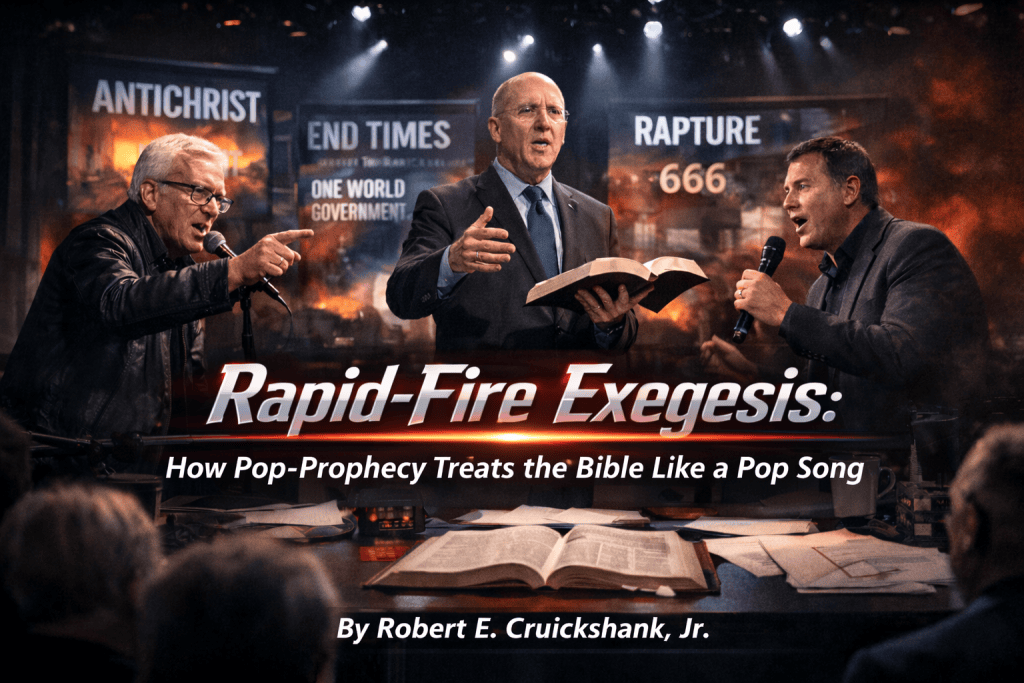
Rapid-Fire Exegesis: How Pop-Prophecy Treats the Bible Like a Pop Song
By Robert E. Cruickshank, Jr. (February 8, 2026).
[7-Minute Read Time]
“Never wanted to be no pop singer, never wanted to write no pop songs”
– From Pop Singer, by John Mellencamp[1]
The famous quote, “Any text without a context is pretext for a prooftext,” has been variously attributed to Derke Bergsma,[2] R. B. Kuiper,[3] D. A. Carson,[4] and others.[5] Regardless of who originally said it, the truth of what it says is what truly matters (1 Cor. 3:5-9). And that truth matters today now more than ever – in a time when pop-prophecy rises to new levels with the rise of social media.[6]
To echo the cautionary note in that time-tested quote, the prophecy pundits routinely take many texts out of context as prooftexts for their eschatology. They rattle off passages so fast that it rattles your brain listening to them rattling the Bible to pieces. This Shake Rattle & Roll[7] methodology was popularized by Jack Van Impe. He was well-known known for his “ability to rattle-off scripture verses at such a rapid-fire rate.”[8]
Handled this way, Scripture becomes a collage of disconnected verses and a barrage of detached soundbites that the hearer can’t possibly hope to absorb or retain. It becomes nothing short of a razzle dazzle, meant to amaze rather than truly explain. While entertaining in its pace and volume, Van Impe’s approach was low on substance and heavy on spectacle.
Pleasant to the ears? Perhaps. But it won’t help you understand a single verse.
Play Me a Song[9]
If you’re around my age or older, you probably remember Billy Joel’s song, We Didn’t Start the Fire. If you’re too young to remember, give it a listen. It’s a great song. As the saying goes, “they don’t write ‘em like that anymore.”[10]
The song is a fast-paced, rapid-fire lyrical collage that races through decades of historical events, cultural flashpoints, political figures, and global crises. With barely a pause for breath, Joel strings together person after person, headline after headline, and topic after topic. Each verse piles on names, moments, and events faster than the listener can process them.
Here are the first 60 seconds of the song:
Harry Truman, Doris Day, Red China, Johnnie Ray
South Pacific, Walter Winchell, Joe DiMaggio
Joe McCarthy, Richard Nixon, Studebaker, television
North Korea, South Korea, Marilyn MonroeRosenbergs, H-bomb, Sugar Ray, Panmunjom
Brando, “The King and I”, and “The Catcher in the Rye”
Eisenhower, Vaccine, England’s got a new queen
Marciano, Liberace, Santayana, goodbye[11]
While this is great for a pop song, this is no way to handle Scripture. But this is exactly how pop-prophecy does it. The prophecy pundits pop out the passages one after another, non-stop. Trying to follow their pop-up exegesis makes you want to drop!
Pop, Pop, Pop Exegesis[12]
I was recently reminded of this while listening to two pop-prophecy YouTubers. The first was Pastor Gary Hamrick and his video The Antichrist, The Rapture, and 2nd Coming of Jesus Explained. The second was Doug Batchelor’s rather well-produced Armageddon and the Final Events of Bible Prophecy. Both Hamrick and Batchelor do the hopscotch hermeneutic all over the pages of Scripture and string together unrelated passages in a maddening frenzy – it made me dizzy!
It felt like I was listening to a parody of We Didn’t Start the Fire:
Beast system, Antichrist, one-world cashless trade
Mark of man, microchips, liberty to be weighed
Red moons, blood skies, famine, wars and plagues
Third temple, rebuilt altar, end-times stageGog and Magog, Russia, China, Middle East
Ezekiel headlines every week at least
Digital currency, global ID
Tribulation, rumors and war, Matthew twenty-four
Again, great for a song but a bad way to approach or interpret the Bible. Prophecy pundits like Hamrick and Batchelor should leave the hopscotching and montaging to Billy Joel.
Nonetheless, let’s use the Piano Man[13] himself as an analogy to make a larger point.
2000 Years from Today
Let’s say that Billy Joel’s timeless classic truly becomes timeless, and someone spins this classic tune 2000 years from now.
For that person to understand what Billy Joel was singing about, he’d need to understand what the lyrics are talking about. Using We Didn’t Start the Fire as an example, along with Bye, Bye, Miss American Pie (Don McLean) and Sweet Home Alabama (Lynyrd Skynyrd), Gary DeMar points out that each song “is filled with historical references that have a specific meaning to the author of the song and are understood in terms of their historical context and their relevance to a particular era.”[14]
Additionally, many of these “historical references” are metaphorical in nature and obviously not meant to be understood literally.
For example, Billy Joel refers to “The Catcher in the Rye.” The lyrical line comes from J.D. Salinger’s 1951classic coming-of-age novel, which bears that title. The title itself was taken from a Robert Burns poem, “Comin’ Thro the Rye.”[15] In Salinger’s novel, the main character, Holden Caulfield, imagines himself growing up to be a hero who catches children in the field of life before they start to go over the cliff and fall into adulthood.[16]
This quick and cursory sketch barely scratches the surface for understanding the song’s simple 5-word line. Much more could be said about the book, the poem from which the book’s title came, the cultural impact of the book, and the controversy surrounding it. In short, there a lot more we could unpack regarding “The Catcher in the Rye.” And that is just one line in the song!
For another example, how would a person 2000 years from now understand this line: “JFK blown away”? What does “JFK” stand for, and what does “blown away” mean? How can letters in the alphabet be “blown away”?
All of this is to say that the listener, in the far-distant future, would have to understand the time, the historical context, and the use of the song’s idioms when the song itself was originally written and sung.
More to the point, it would be absurd for this future person to think the song’s lyrics could possibly be understood in light of his own modern context or the current events of his own day.
It’s no different when interpreting the Bible.
Too Much to Track at Once
With that said, trying to track and unpack every passage that Hamrick and Batchelor fire out would be like trying to comment on everything that We didn’t Start the Fire is about .
That would exceed my space limitations and fatigue your patience! So, let’s look at just one example from the messages of the pundits to illustrate the point – before we both burn out in this “fire” that the pundits “started.”
We’ll pick one that routinely tops the charts of pop-prophecy’s playlist.
Ten Regions, One Antichrist, Seven Years
In the course of his presentation, Gary Hamrick says, “The Bible actually predicts that the world powers will be divided into 10 geographical regions.” These 10 geographical regions “will then give power to one person that we know of as the antichrist.” The whole thing will last for “seven years,” according to Hamrick.[17] The concept comes from the 10 horns of the Beast in Revelation 13:1, which pop-prophecy commonly sees as these 10 “regions or zones of the planet earth.”[18]
The problem is that Revelation 13 mentions nothing about the Antichrist nor a period of seven years. This is the hopscotch hermeneutic, once again. Then, they do their zigzag exegesis. Without the listener even being aware of what they are doing, they are filling in the details by going to other passages. The prophecy pundits must run to other parts of the Bible and piece these things together like patchwork to create their composite mosaic.
The pundits then claim that this mosaic they’ve created is a picture of our world today. A slideshow of current events imposed on ancient text. A prophetic Instagram feed of today’s headlines.
But interpreting the Beast’s 10 horns in light of modern times, 2000 years after John wrote Revelation, would be like that person 2000 years from now trying to interpret Billy Joel’s reference to “Catcher in the Rye” in light of his own time – centuries after the song was written.
Just like the future listener who will have to put himself back into Billy Joel’s time to understand Billy Joel’s song, we need to put ourselves back into John’s time to understand John’s book.
Gotta’ Get Back in Time[19]
When we leave the world of the twenty-first century, and enter John’s world of the first century, his meaning opens up. The Beast rises from the sea in Revelation 13:1, and this would symbolize the rise of the Roman Empire for John and his original audience.[20] As Ian Paul observes,
“Geographically, John can see the shore from Patmos as he looks north and east towards the cities he is writing to; for the residents of Asia, the power of Rome has come to them across the sea, but the local leaders who enable and enforce the practices of the imperial cult come from their own land.”[21]
This being the case, Ken Gentry discusses how the Sea Beast’s 10 horns would have been understood within the context of John’s own time:
“Historically, the ten kings symbolized here by horns may represent Roman governors (legati or procuratores) or proconsuls governing the ten leading provinces of Rome: Italy, Achaea, Syria, Asia, Egypt, Africa, Spain, Gaul, Britain and Germany (Ford 220; cp. Renan 203, 206; Farrar 464n; Robinson 1976: 251), though in 17:16, Rome’s action against Jerusalem in the Jewish War suggests that the ten kings involve only the eastern provinces and their appointed political authorities. Or (preferably) the ten kings may be client kings, such as Antiochus, Agrippa, Sohemus, and Malchus who provided auxiliary forces for Rome during the Jewish War (J.W. 2:18:9 §499–503; 3:4:2 §168) (cf. Aune 951; Stuart 2:327). Rome’s power was projected throughout the imperial realm by means of her provincial government and her system of client kings. Though Rome’s power was centrally concentrated in Rome, it was immanently present in affairs throughout the enormous empire.”[22]
In short, when viewed through John’s eyes, the Sea Beast and its ten horns symbolize the Roman Empire and its local and client rulers, not some far-future global confederation.
Revelation 13:10 is but one among many passages that the prophecy pundits abuse to buttress their views. It’s one among many passages in which the context is ignored as their narrative is forged. It’s one among many passages which they manipulate while they pontificate…and bloviate.
To counter this, believers need to self-educate.
Putting Out the Pop-Prophecy Fire
To that end, the commentaries referenced above, by Ian Paul and Ken Gentry, are two wonderful resources in this regard. Other helpful resources along these lines can be found here at Cruickshank’s Corner as well as The American Vision Bookstore.
So, let’s slow down and read the Bible carefully. Let’s mute the noise of prophecy punditry. Let’s devote ourselves to serious study – and leave the pop songs to Billy Joel.
Copyrights and Credits: Copyright ©Robert E. Cruickshank, Jr. (February 8, 2026), All Rights Reserved; Daniel E. Harden (Editor), Brett Prieto (Proofreader), blog header image ©Robert E. Cruickshank, Jr., All Rights Reserved.
____________________________________________________________________________________________________________________________________________
[1] Pop Singer, by John Mellencamp https://bit.ly/4bHPqta
[2] R. Scott Clark, Any Text Without A Context Is Pretext For A Prooftext (May 16, 2025) | The HeidelBlog https://bit.ly/3MtjK0d
[3] Clark, Any Text
[4] Carson Quote Identity | Logos Community https://bit.ly/4rB7da1
[5] A text without a context is a pretext | Reading Theology https://bit.ly/3OpmxrO
[6] On the increased influence of pop-prophecy through modern digital platforms and the danger this poses to young people, see: Robert E. Cruickshank, Jr., The Dangers of Doomsday Indoctrination: The Kids Aren’t Alright | It’s about time https://bit.ly/4a3lUgb ; Robert E. Cruickshank, Jr., The Adventures of Doctor Date Setter | The Burros of Berea https://bit.ly/3Mb311K
[7] From Shake Rattle & Roll, by Bill Haley & His Comets https://bit.ly/4qgNICn
[8] Jack Van Impe, RIP | The Way of Improvement Leads Home https://bit.ly/4kmYEx1
[9] From Piano Man, by Billy Joel https://bit.ly/4qZw9YG
[10] From “The Break Up Song,” Greg Kihn Band https://bit.ly/4aeaFQR
[11] We didn’t Start the Fire | Lyric Genius https://bit.ly/4tgx1tC
[12] From M (Robin Scott), “Pop Muzik” https://bit.ly/4rwWCg6
[13] The Story of Billy Joel and How He Became the “Piano Man” | The Science Survey https://bit.ly/4bBWuYb
[14] Gary DeMar, A Beginner’s Guide to Interpreting Bible Prophecy: a Five-Part Study (Powder Springs, GA: American Vision, 2026), 14.
[15] The Catcher in the Rye Central Idea: What Does the Title Mean? | Spark Notes https://bit.ly/3L QN9kU
[16] Catcher in the Rye | Spark Notes
[17]The Antichrist, The Rapture, and 2nd Coming of Jesus Explained – Maybe God Podcast | YouTube, 11:59-12:29 https://bit.ly/4r5XOHN
[18] See: Dr. Andrew M. Davis, Revelation Episode 16 – The Beast from the Sea (September18, 2024) | Two Journeys https://bit.ly/4qjHstO
[19] From Back in Time, by Huey Lewis & The News https://bit.ly/4axnmHL
[20] Undergirding this imagery is the overall Leviathan motif, a common literary trope in the ancient world, meant to convey the idea that chaos has returned. For more on this, see: Robert E. Cruickshank, Jr., Identifying the Sea Beast of Revelation | It’s about time https://bit.ly/3Lsm9rq
[21] Ian Paul, Tyndale New Testament Commentaries [TNTC]:Volume 20 – Revelation (Downers Grove, IL: IVP Academic, 2018), 230.
[22] Kenneth L. Gentry, Jr. The Divorce of Israel: A Redemptive-Historical Interpretation of Revelation, volume II: Revelation 10:1–22:21(Acworth, GA: Tolle Lege Press; Vallecito, CA: Chalcedon Foundation, 2024),1050.