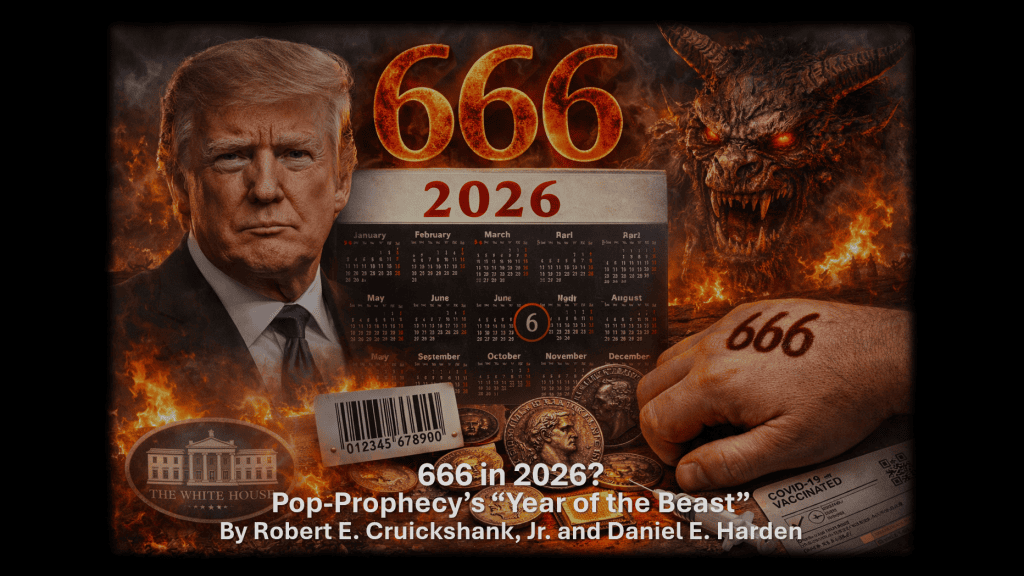
666 in 2026: Pop-Prophecy’s “Year of the Beast”
By Robert E. Cruickshank, Jr. and Daniel E. Harden
Copyright © Robert E. Cruickshank, Jr. (January 17, 2026)
Daniel E. Harden and Chuck Coty (Editors)
All Rights Reserved
The supreme embodiment of hostility to Christians was the emperor Nero. When the finishing touches were put onto the image of the beast, Nero sat for the portrait.
– Craig R. Koester[1]
Dr. Cliff Kelly has officially named 2026 “The Year of the Beast.”[2] He calls this a “well-informed, reasonable, theologically sound thesis.”[3] Of course, in this thesis of his, Donald Trump is the Antichrist, and the Antichrist is the Beast. This is despite the fact that the Beast and the Antichrist are two different personages in the Bible, and Donald Trump isn’t even a person in the Bible at all.[4]
While Trump might be pleased with the idea of having been mentioned in the Bible, he would most likely balk at the thought of being identified as the Beast of Revelation. Fake news, he’d say. Very fake news.
Similarly, Kelly’s prophecy-by-the-press YouTube release will go down in history as just that – fake news. The Apostle John wasn’t suffering from Trump Derangement Syndrome in the book of Revelation, and Kelly’s thesis is neither “theological” nor “sound.”
No Guardrails
As Professor Frances Flannery notes, “Mainstream biblical scholars interpret the Beast as a symbol for the Roman Empire,” with “Nero Caesar” being the man whose name equals 666.[5] The problem is that mainstream Christians aren’t apt to read mainstream scholarship, as they favor downstream sensationalism instead.[6] This leaves Nero scoring a zero on the pop-prophecy charts, and the seat of the Beast waiting to be filled by whoever is generating the latest news-making thrills. For the moment, it’s Trump. But that could change. It always does.[7]
Hence, the irony of all of this.
The fact is that the prophecy pundits’ calculations have scored at least six hundred and sixty-six zeros over the years. Hyperbole? Maybe. But the point is that present-day prophecy punditry has a perfect legacy – a 100% failure rate. And you can bet your bottom dollar that Kelly’s “thesis” will be remembered for its astonishing absurdity rather than its astute accuracy.
Tracking on the propensity to confuse the Antichrist with the Beast, John D. Doss puts it well: “Indeed, what else could the Pope, Barney the dinosaur, Nazi Germany, and Ronald Reagan all have in common, other than that each has been posited as a fulfillment of biblical prophecy concerning the antichrist?”[8] While all of this is old news, there’s always a new Pope or a President there to fill the Beast’s shoes – because one size misfits all equally, in the world of pop-prophecy.
Perhaps Barney the dinosaur would be the prophecy pundits’ best fit considering Revelation 13:1’s Leviathan imagery? After all, when Biblical exegesis goes out the door, Biblical terminology devolves into comedy.
The sad reality is that Pop-Prophecy’s track record of comedic failure tracks on how the Church has failed society, as the pundits’ failed version of the Beast has become a pop-culture phenomenon. This is where the whole thing becomes as serious as it is silly. Without the hermeneutical guardrails in place, there is no stopping the runaway collision between bad theology and mass credulity.
No Stop Signs, Speed Limits[9]
When it comes to identifying the Beast in Revelation 13, pop culture tailgates the mainstream Church as it follows pop-prophecy rather than Biblical history.
Even Wikipedia notes the penchant in “modern popular culture” to run counter to the “broad consensus in contemporary scholarship that the number of the beast refers to the Roman emperor Nero, who reigned from 54 to 68 AD.”[10] Sadly, pop-prophecy continues to shape the public imagination far more than Biblical exegesis regarding the number 666.
The numerological fear runs deep in the cultural imagination, as some people even develop a persistent and irrational fear of the number 666, known as hexakosioihexekontahexaphobia.[11] Like all phobias, this has real-life side effects.
One specific example is former U.S. Highway 666, off Route 66, in New Mexico. This proved to be an especially dangerous stretch of roadway as “23% of all crashes involving injury in the Shiprock District were on a 0.9-mile stretch of Highway 666.”[12] Accordingly, Highway 666 was nicknamed the “Devil’s Highway” among people who frequently traveled the road. The Federal Highway Administration of the U.S. Department of Transportation even officially dubbed it the “Beast of a Highway,” and renamed it to U.S. 491 in 2003.[13]
The bottom line is that the anxiety over the number, while people were driving, sometimes resulted in accidents on the highway. It was cyclical, like a self-fulfilling prophecy – even though none of this had anything to do with prophecy in the first place. But fear can be a powerful instigator.
With that said, fear associated with the number 666 is also a recurring theme in some modern movies as well, and the theme of 666 often hits the big screen. A number of horror movies incorporate the fear associated with 666 into their script.
For example, two years before the highway’s name change, the movie Route 666 was a 2001 action horror film, where government agents are besieged by the ghosts of a massacred chain gang while driving down the infamous highway.[14] Before that, in 1998 there was a movie called Flight 666, where the plot revolved around the spirits of dead children taking revenge on a passenger. The 1994 film Natural Born Killers, an Oliver Stone classic, contains a scene of murderous rampage on Highway 666.[15] Going back even further, in the 1976 classic The Omen, the child Damien has the birthmark 666 on his scalp, as an indication that he is the Antichrist. Many other horror films have used the depiction of the number 666 to emphasize demonic activity.
But highways, flights, birthmarks, and depictions using the number 666 have about as much to do with the actual Biblical significance of six-six-six as the prophecy pundits’ imagination that spawned all of this. In other words, none, zip, zero-zero-zero.
The blind are leading the blind, and the truth gets left behind, as the roadway is cluttered with the wreckage of misapplied prophecy. One might even say, “The highway’s jammed with pop-prophecy heroes on a last chance power drive.”[17]
Theological Robotics
One of those “heroes,” Tiff Shuttlesworth, recently released a video driving his theory about robots in Bible prophecy – a video that has garnered around twenty thousand views per month.
Shuttlesworth opens by promising the viewer: “You will be blown away by…some of the content that I’m going to share.”[18] He says he’s “committed to seeking Biblical understanding and carefully examining end-time Bible prophecy,”[19] and he wants to become “a trusted voice in your life.”[20] Specifically, Shuttleworth wants you to trust his claims that Revelation 13:14-15 is about “humanoid giant robotic technology,” in the form of a “statue,” that was “an absolute impossibility…until recent years.”[21]
By “recent years,” Shuttleworth is referring to the pivotal years of 2023 and 2024,[22] when AI technology and advanced robotics merged to the point that fantasy meets reality, and Revelation’s beastly image could finally emerge – or at least his fantasy version of it. But the Image of the Beast in Revelation 13 should cause us to look back to the book of Genesis, rather than looking to the future for a cyborg, to understand what John is communicating with the imagery of the beast’s image.
The Imagery Behind the Image
The theological messaging of Revelation 13 takes us all the way back to the original creation account, where human beings were created to be God’s image bearers in this world. As Rebekah Yi Liu observes: “The Bible starts and ends with the making of an image. The first mention of making an image is found in Gen 1 – the making of human beings in God’s image. The language of Revelation 13 alludes to the Genesis story of the creation of human beings. Verbally, the language of Revelation 13 parallels the language of creation in Genesis 1-2.”[23] This becomes evident when we take a moment to think about the key words that John uses in Revelation 13.
The settings in both Genesis 1-2 and Revelation 13 are similar, in that the same nouns occur in both passages: sea (Gen 1:10; Rev. 13:1), land (Gen 1:10; Rev. 13:11), beasts (Gen 1: 24; Rev. 13:1, 11), and image (Gen 1: 26; Rev. 13:14).[24]
The same is true of the verbs used in both passages as well.[25] In Genesis, God makes man in his own image (Gen. 1:26) and breathes life into his nostrils (Gen. 2:7). In Revelation 13, an image is made of the Sea Beast, and life is breathed into it (Rev. 13:14-15). This represents, what Yi Lui calls, “a reversal of the creation account.”[26]
This makes sense, as the original creation account was about God bringing order out of chaos, while John’s Leviathan imagery telegraphs the idea that chaos has returned – in the form of the Roman Empire.[27] Man was designed to reflect the image of God in the world, helping to bring order to it (Gen. 1:26-28). Nero was doing the opposite, and he became the image of the opposite – he became the image and incarnation of chaos.[28]
So, the theological messaging behind the imagery of the beast presents a deliberate reversal of man’s role in creation. Instead of reflecting God’s image and bringing order to society as a ruler is supposed to do (Rom. 13:1-6),[29] Nero and the Roman Empire became a counterfeit image that embodied chaos and spread destruction.[30] The picture John paints in Revelation 13 is not one reflecting futuristic technology, rather it is a theological portrait of imperial power usurping God’s place and deforming its own God-given place and role in this world.[31]
Likewise, the prophecy pundits are very much deforming what the text was intended to mean.
Ancient Robotics
Getting back to Shuttlesworth… For what it’s worth, the world didn’t have to wait for the technology of recent years to see a statue move.
As Ian Paul points out,[32] animated statues were a known feature of ancient religious life. The most famous example is the Automate Therapaenis (automatic maid), a “technological miracle” of the 3rd century BC considered “the world’s first robot.”[33] Through mechanical devices (automata using gears, weights, air pressure, water, and pulleys), statues could move, pour liquids, make sounds, or appear “alive.” These were especially common in cultic settings, where they created awe and reinforced the idea that divine power was present. The effect was to blur the line between the human and the divine.
In other words, animated, moving statues were not unknown in John’s time. This led Steven J. Scherrer to conclude: “In the light of all this it seems quite plausible that technology and simulation of nature might also have been employed in the imperial cult. We suggest that Rev 13:13-15 should be accepted as describing a part of the actual practice in the cult of the princeps in the East.”[34]
In short, even if the passage is about moving statues,[35] it still fits comfortably within the technological and religious realities of John’s own world.[36] Neither the theological messaging behind The Image of the Beast, nor the technology needed for it to take on a concrete historical expression, waited for “recent times” to become a reality – and John was speaking to the realities of his own time.
So, we’ve talked about the Beast (it’s not about a modern political figure), the number of the Beast (it’s not about modern numerology), and the Image of the Beast (it’s not about a cybernetic being from a sci-fi movie). But no discussion of the Beast would be complete without also mentioning the infamous Mark of the Beast.
The Mark of the Beast
Over the years, Prophecy punditry has identified the Mark of the Beast as everything from UPCs (Universal Product Codes) to Monster Energy drinks.[37] In the 2020’s, the COVID Vaccine and microchips made the list.[38] Jack Chick publications says that whatever the Mark of the Beast is, people will “flock to get it, like an app on their smartphones.”[39]
That said, who can forget the cover of the Chick tract, “The Beast,” which portrayed your average middle-class family with 666 tattooed on their foreheads, as the mother enthusiastically lifts her young child to be blessed by an ominous figure (presumably the Beast)? The irony in all of this is that the tract itself is now offered in PDF form through the very “use of computers” through which Jack Chick said, “the Beast will be able to control every person on the globe.”[40]
Such was the world of the 1970’s and Chick tracts and comic books.
Getting back to the world of the Bible, John’s readers would have made a connection back to Leviticus 13:9 and Deuteronomy 6:6-8, where God’s Law was to be a sign bound on their hands and forehead to remind the Israelites where their loyalties lie.[41] As Ken Gentry says, “This is dramatic imagery, not literal reality.”[42] And it’s not terribly difficult to figure out what that imagery represents. “Every Jew would have understood what a mark on the hand and forehead meant,” writes Gary DeMar.[43] The mark of the beast, in essence, is a reversal of the requirement that God’s Law alone govern our thoughts and actions.[44]
The first-century Christians were faced with the reality that they could not serve two masters. It’s the same reality that many who had gone before had faced. It is a choice between following the commands and precepts of the Lord or following a foreign set of commands and precepts contrary to the Lord’s. Thus, John specifically contrasts receiving the mark of the beast with keeping the commandments of God (Rev. 14:11-12).[45]
It’s not a choice between deciding if the mark of the beast is about UPC codes, Monster Energy Drinks, microchips, or vaccines. It has nothing to do with any of those. Again, zero.
Application for Today
What, then, does all of this mean for us today?
Bryce Morgan summarizes it all nicely: “The ‘mark’ of the beast is the world’s ‘stamp of approval’ on those who compromise and conform as people-pleasers, rather than God-pleasers.”[46] Taken in this light, all of this continues to have relevance and application for us today, but not in the pop-prophecy way. Rather than thinking about barcodes, vaccines, and robots, perhaps we should be thinking about where our own loyalties lie? Does God’s word govern our thoughts and actions, or do we let a different set of values determine how we think and what we do?
Past fulfillment doesn’t negate current application. On the contrary, it grounds it. But when we miss the original meaning of the text, we miss all the meaning that it might have for us today as well. Instead, we waste our lives waiting to see who the next Beast or the Antichrist will be tomorrow. Such is the legacy of pop-prophecy. It trains us to look for signs and wonders, instead of being living signs to the world of the wonders of God’s love and the truth of His word.
Meet the New Beast, Same as the Old Beast[47]
Pop-prophecy’s Beast will change clothes again after Donald Trump fails to fulfill a prophecy that was already fulfilled by Nero Caesar nearly 2000 years ago. It’s all the same, and only the names will change.[48] Yesterday’s failed predictions will once again get recycled tomorrow under a new label.
So, we end where we began. Dr. Kelly’s “Year of the Beast,” like so many before it, is not a breakthrough in biblical understanding but another unraveling in pop-prophecy’s long record of creative misidentification. The Beast is still not a modern political figure, 666 is still not a numerological code for the future, the Image of the Beast is still not a cybernetic lifeform, and the Mark of the Beast is still not a microchip.
John was not predicting twenty-first-century technology; he was confronting first-century realities.
At the end of the day, prognostications surrounding the number 666 in 2026 tell us far more about our failures to understand the book of Revelation than it does about the book of Revelation itself. The Beast keeps getting rebranded, while sound interpretation keeps getting ignored. And that’s the real tragedy of pop-prophecy.
Perhaps we should make 2026 the Year of Biblical Literacy, instead of the Year of the Beast?
Just a thought.
___________________________________________________________________________________________________________________________________________________________
[1] Craig R. Koester, Revelation and the End of All Things (Grand Rapids, MI: William B. Eerdman’s Publishing Company [ePub edition], 2018), 147.
[2] Dr. Cliff Kelly, Special Notes on 2026 – The Year of the Beast (with Video) https://bit.ly/4qhxud3
[3] Kelly, Year of the Beast, 4:44
[4] One might be tempted to say that Nero isn’t specifically named in the Bible either. While it’s indeed true that he is not mentioned by name, we do know “the number of his name” (Rev. 13:17). As pointed out in the body of this article, it is widely recognized in scholarship that “six hundred and sixty-six” (Rev. 13:18) is gematria for Nero Ceaser. Additionally, as Ken Gentry says, “Nero’s footprints are all over Revelation” (Before Jerusalem Fell: Dating the Book of Revelation (Tyler, TX: Institute for Christian Economics, 1989), 352.
[5] 666 in Popular Culture – Bible Odyssey https://bit.ly/4pBge1m
[6] To be fair, there are also mainstream Christians who are taught and who believe that the gematria 666 refers to or could refer to Nero, all while also believing that the Antichrist is a future demonic figure that will control the world.
[7] Case in point: Ronald Reagan, who was president of the United States from 1981 to 1989, garnered a huge amount of attention among the pop-prophecy pundits of the day. It wasn’t because of anything he did. It was simply that his name was Ronald Wilson Reagan – 6 letters in each name, thus leading people to believe that this meant 666.
[8] The Mark of the Beast: Reflections on the Bible’s Most Notorious Prophecy — Firebrand Magazine https://bit.ly/4sM8xs7
[9] From the lyrics of Highway to Hell, by AC/DC https://bit.ly/4qlXfcc
[10] 666 (number) – Wikipedia https://bit.ly/4sFPG1y
[11] Very Well Mind – Fear of the Number 666 https://bit.ly/49qYbEU
[12] Very Well Mind – Fear of the Number
[13] Federal Highway Administration – 666: Beast of a Highway https://bit.ly/4sCbfAc
[14] Route 666 (film) – Wikipedia https://bit.ly/4qiQnfD
[15] Shout out to Brett Prieto for this reference!
[17] To parody Born to Run, by Springsteen https://bit.ly/4pNY5xB
[18] Tiff Shuttlesworth, Is the Image of the Beast In Revelation 13 Actually Artificial Intelligence?, 46:00 https://bit.ly/3NKLjST
[19] Shuttlesworth, Is the Image of the Beast, 2:29-2:35.
[20] Shuttlesworth, Is the Image of the Beast, 2:10-2:11.
[21] Shuttlesworth, Is the Image of the Beast, 24:26-24:50.
[22] The History of AI – Everything You Need to Know — Scottish AI Alliance https://bit.ly/4qZhFI9
[23] “The Background and Meaning of the Image of the Beast in Rev. 13:14, 15” by Rebekah Yi Liu (Digital Commons @Andrews University, James White Library: Dissertations), 97. https://bit.ly/4qNSgRu
[24] Yi Liu, Background and Meaning, 97.
[25] Yi Liu, Background and Meaning, 97.
[26] Yi Liu, Background and Meaning, 98.
[27] This is nothing new. The prophets often referred to the coming exile in terms of de-creation and a return to chaos. See: Robert E. Cruickshank, Jr., Zephaniah at World’s End: A Modern Misunderstanding of an Ancient Motif – The Burros of Berea https://bit.ly/3Ethj9Q
[28] As David Chilton noted: “…Nero and the Empire were sunk in degrading, degenerate, bestial activities. Nero, who murdered numerous members of his own family (including his pregnant wife, whom he kicked to death); who was a homosexual, the final stage in degeneracy (Rem. 1:24-32); whose favorite aphrodisiac consisted of watching people suffer the most horrifying and disgusting tortures; who dressed up as a wild beast in order
to attack and rape male and female prisoners; who used the bodies of Christians burning at the stake as the original ‘Roman candles’ to light up his filthy garden parties; who launched the first imperial persecution of Christians at the instigation of the Jews, in order to destroy the Church; this animalistic pervert was the ruler of the most powerful empire on earth. And he set the tone for his subjects. Rome was the moral sewer of the
world” (The Days of Vengeance: An Exposition of the Book of Revelation (Tyler, Tx: Dominion Press, 1987), 329.
[29] See: Greg L. Bahnsen, Theonomy in Christian Ethics (Phillipsburg, NJ: Presbyterian and Reformed Publishing Company, 1984), 365-400.
[30] According to Phil Kayser, “…history makes it quite clear that multiplied millions of Christians were tortured in the most hideous ways and killed for their faith between the years 62 and 68 AD. B. H. Warmington examined the secular evidence of persecution of Christians in Rome and believed that “almost the entire Christian community at Rome was destroyed.” The Right Honorable Charles Kendall Bushe said that Tacitus and Seutonius show how “…Christians, were persecuted, and almost exterminated, by Nero…” Divine Guidance for Understanding the Book of Revelation, part 12 | Biblical Blueprints https://bit.ly/3YFWiPW
[31] And the Jewish religious leaders, rather than denouncing Nero’s activities, actually fell in league with Nero in their overzealous attempt to exterminate Christians. They are represented by the land beast later in chapter 13.
[32] Ian Paul, Robotics, technology, and reading Revelation 13 | Psephizo https://bit.ly/4jJyuEE
[33] This is the world’s first robot https://bit.ly/3Za7sfX
[34] Steven J. Scherrer, “Signs and Wonders in the Imperial Cult: A New Look at a Roman Religious Institution in the Light of Rev 13:13-15” (Journal of Biblical Literature, 103/4 [1984]), 610.
[35] David Chilton, for example, doesn’t believe this is the case: “While some have argued that this refers to some trick of machinery or ventriloquism … it is more likely that the passage as a whole is intended to convey the idea of an apostate Jewish attempt to recreate the world.” (The Days of Vengeance: An Exposition of the Book of Revelation (Tyler, Tx: Dominion Press, 1987), 341. He further explains this as: “The leaders of Israel worked to enforce worship, not of the true God, as in the Christian churches, but of the Synagogue itself – the image of the Beast.” (ibid.) 344.
[36] As Daniel Morais writes: “It is possible that ventriloquism and counterfeit miracles were performed with the ensigns under Titus’ direction in the Temple in Jerusalem in A.D. 70 as this appears to have been a common practice in the pagan Temples of Syria, Judaea’s northern neighbor and the province in which much of Titus’ army was drawn. The following is written concerning the pagan temples of Syria in the second century A.D.: “ ‘The statues sweat, and move, and utter oracles, and a shout has often been raised when the temple was closed; it has been heard by many’ ” (Daniel Morais, Revelation Revolution – Revelation 13: A Preterist Commentary https://bit.ly/4t0jFlg ). Morais here cites Lucian, De Syria Dea 10.
[37] Bar codes, vaccines, chip implants, and the mark of the beast – New City Church https://bit.ly/4qrgbGE
[38] Are Embedded Microchips the Mark of the Beast? – The American Vision https://bit.ly/3LAjps3
[39] Chick.com: It Won’t Be That Hard to Get People to Accept the Mark of the Beast https://bit.ly/49jSeLo
[40] The Beast Bible Prophecy Tract (Chick Publications) https://bit.ly/3LtNlGs
[41] See: Robert E. Cruickshank, Jr., Missing the Mark of the Beast | It’s about time https://bit.ly/4sMHNrt
[42] Kenneth Gentry, The Book of Revelation Made Easy: You Can Understand Bible Prophecy (Powder
Springs, GA: American Vision), p. 67.
[43] Are Embedded Microchips a Sign that We’re Living in the Last Days? • Gary DeMar https://bit.ly/3Z3Wb0V
[44] So, this is a spiritual principle, based on a real-world term, that had spiritual significance in the real world at the time. As Ian Paul states, “But the primary significance of this mark (charagma) is not in relation to any literal marking, but as a counterpoint to the seal (sphragis) of protection given to the faithful people of God. Within the narrative, the two (mark/seal) are mutually exclusive (see 20:4), and all of humanity has either the one or the other. Both are put on the forehead, and it turns out that both represent the name of the one that they follow” (Ian Paul, Revelation: Tyndale New Testament Commentary Series [TNCT], Volume20 (Downers Grove, IL: IVP Academic, 2018), 238.
[45] For possible ways in which the mark could have taken on some real-life historical dimensions, such as possible connections to Roman coinage and monetary policy as well as Roman census taking, see: Morais, Revelation 13: A Preterist Commentary https://bit.ly/4t0jFlg and Deborah Furlan Taylor, “The Monetary Crisis in Revelation 13:17 and the Provenance of the Book of Revelation” (The Catholic Biblical Quarterly, Vol. 71, No. 3 [July 2009]), 580-596.
[46] Way of Grace Church: Buckeye, AZ > Receiving the Mark (Revelation 13:15, 16) https://bit.ly/4qXdInb
[47] To parody Won’t Get Fooled Again, by The Who https://bit.ly/4qyCt9E
[48] To channel Wanted Dead or Alive, by Bon Jovi https://bit.ly/4jGWAQ4